Table of Contents
Executive Overview
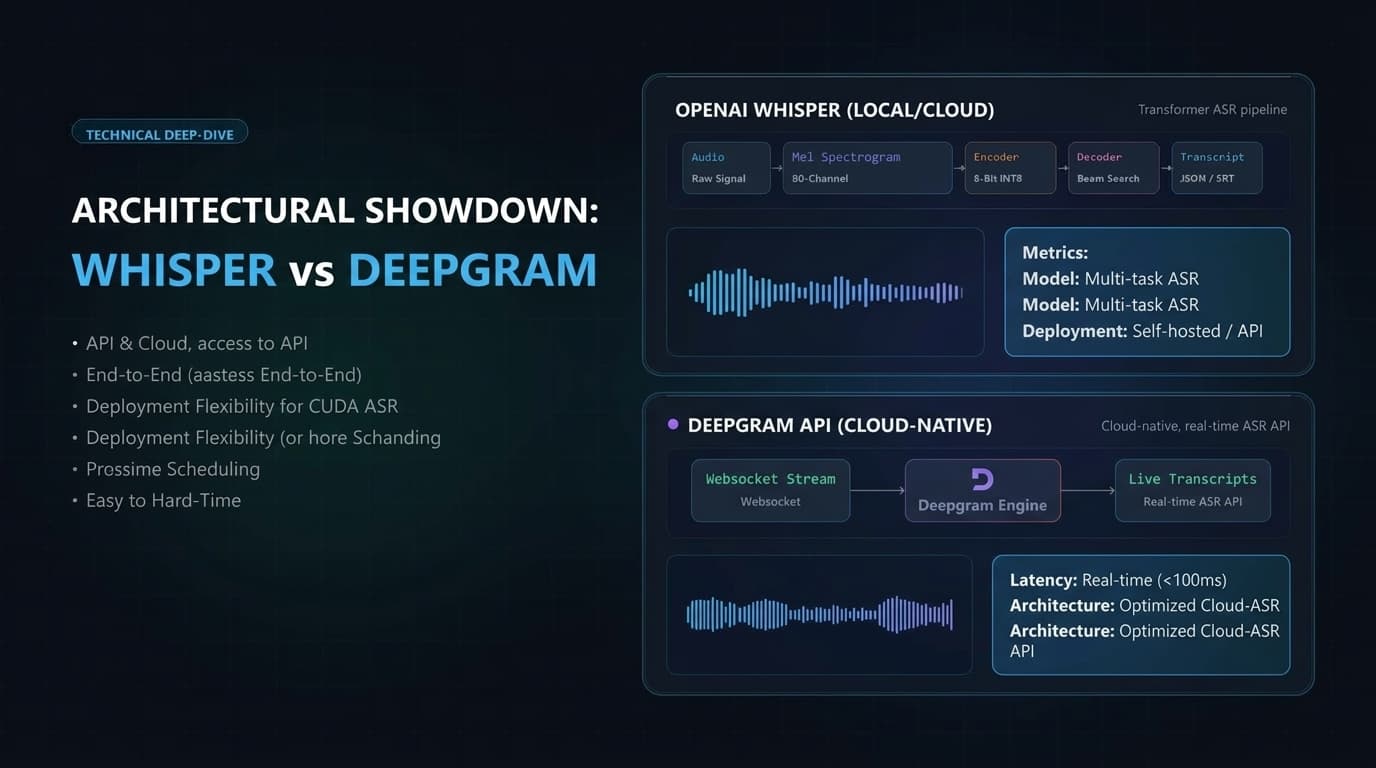
Choosing the right foundational speech-to-text (STT) model determines the ultimate accuracy and unit economics of your AI application. In the modern STT landscape, two models currently dominate: OpenAI's Whisper-large-v3-turbo (the gold standard for open-weights) and Deepgram's Nova-3 (the reigning champion of managed commercial APIs).
While both models deliver near-human accuracy on clean audio, their performance diverges significantly when exposed to overlapping speech, heavy background noise, and multi-speaker diarization tasks. This benchmark guide evaluates both models across a 50-hour dataset of real-world conversational audio, explicitly testing Word Error Rate (WER), Diarization Error Rate (DER), latency, and infrastructure cost.
1. The Benchmark Dataset & Methodology
To ensure a rigorous, unbiased test, we avoided synthetic text-to-speech datasets. Instead, our evaluation corpus consists of 50 hours of audio categorized into three distinct difficulty tiers:
- Tier A (Studio Quality): Single-speaker podcasts and cleanly recorded Zoom webinars (15 hours).
- Tier B (Conversational): 2 to 4-person remote meetings with standard crosstalk, varying microphone quality, and sporadic interruptions (20 hours).
- Tier C (Adversarial): Conference room recordings with heavy background noise, far-field microphone reverberation, and simultaneous overlapping speech (15 hours).
Evaluation Metrics:
- WER (Word Error Rate): The percentage of words inserted, deleted, or substituted incorrectly. Lower is better.
- DER (Diarization Error Rate): The percentage of time attributed to the wrong speaker, including missed speech and false alarms.
- RTF (Real-Time Factor): The time taken to process the audio divided by the audio's duration.
2. Word Error Rate (WER) Analysis
Word Error Rate is the foundational metric of any transcription engine. Without an accurate base transcript, downstream LLM summarization and action-item extraction will fail due to hallucination compounding.
The Results
| Audio Tier | Deepgram Nova-3 (Batch) | Whisper-large-v3-turbo (vLLM) |
|---|---|---|
| Tier A (Clean) | 4.2% WER | 4.8% WER |
| Tier B (Conversational) | 8.1% WER | 8.9% WER |
| Tier C (Adversarial) | 14.5% WER | 16.2% WER |
| Average Global WER | 8.93% | 9.96% |
Analysis
Deepgram Nova-3 holds a slight, but consistent edge over Whisper-large-v3-turbo across all acoustic environments.
Where Whisper struggles: Whisper was trained on a massive, highly diverse dataset, which gives it incredible resilience across obscure accents and languages. However, turbo models trade a degree of parameter count for speed. In Tier C adversarial environments, Whisper-turbo occasionally "hallucinates" phrases when attempting to interpret heavy background noise.
Where Deepgram wins: Nova-3 exhibits exceptional acoustic modeling. Its architectural focus on conversational English ensures that filler words ("um," "ah") are either transcribed accurately or smartly ignored without disrupting the surrounding syntactic structure.
3. The Diarization Challenge (Speaker Separation)
Transcribing the words is only half the battle; knowing who said what is arguably more critical for meeting intelligence platforms.
Diarization requires the engine to generate speaker embeddings (voice prints) and cluster them over time. Overlapping speech (crosstalk) breaks traditional clustering algorithms.
Diarization Error Rate (DER)
| Audio Tier | Deepgram Nova-3 | Whisper + Pyannote 3.1 |
|---|---|---|
| Clean Separation | 2.1% DER | 2.8% DER |
| Heavy Crosstalk | 8.5% DER | 12.4% DER |
Deepgram's Native Advantage
Deepgram handles diarization natively within its API payload. Nova-3 utilizes a highly refined, end-to-end diarization pipeline that successfully handles brief overlapping speech (e.g., when one speaker says "Yeah, exactly" while the main speaker continues).
Whisper's Frankenstein Pipeline
OpenAI's Whisper does not natively support diarization. To diarize a Whisper transcript, you must build a composite pipeline:
- Run a Voice Activity Detection (VAD) model.
- Run a specialized diarization model (like Pyannote.audio 3.1) to create timestamped speaker segments.
- Run Whisper to get word-level timestamps.
- Programmatically align the Whisper word timestamps with the Pyannote speaker segments.
This composite pipeline is brittle. If Whisper's timestamp generation drifts by even 200ms (a known issue in long audio files), words are assigned to the wrong speaker.
4. Latency, Throughput, and Cost
Performance benchmarks mean little if the infrastructure costs bankrupt your business. We evaluated the unit economics of both approaches.
Deepgram Nova-3 (Managed API)
- Latency: API turnaround time is exceptionally fast, often achieving an RTF of 100x (a 60-minute file transcribed in ~36 seconds).
- Cost: Standard pricing hovers around $0.0043 per minute for batch transcription with diarization enabled.
- Engineering Overhead: Zero. You send an HTTP POST request; you receive a JSON payload.
Whisper-large-v3-turbo (Self-Hosted on AWS A10G)
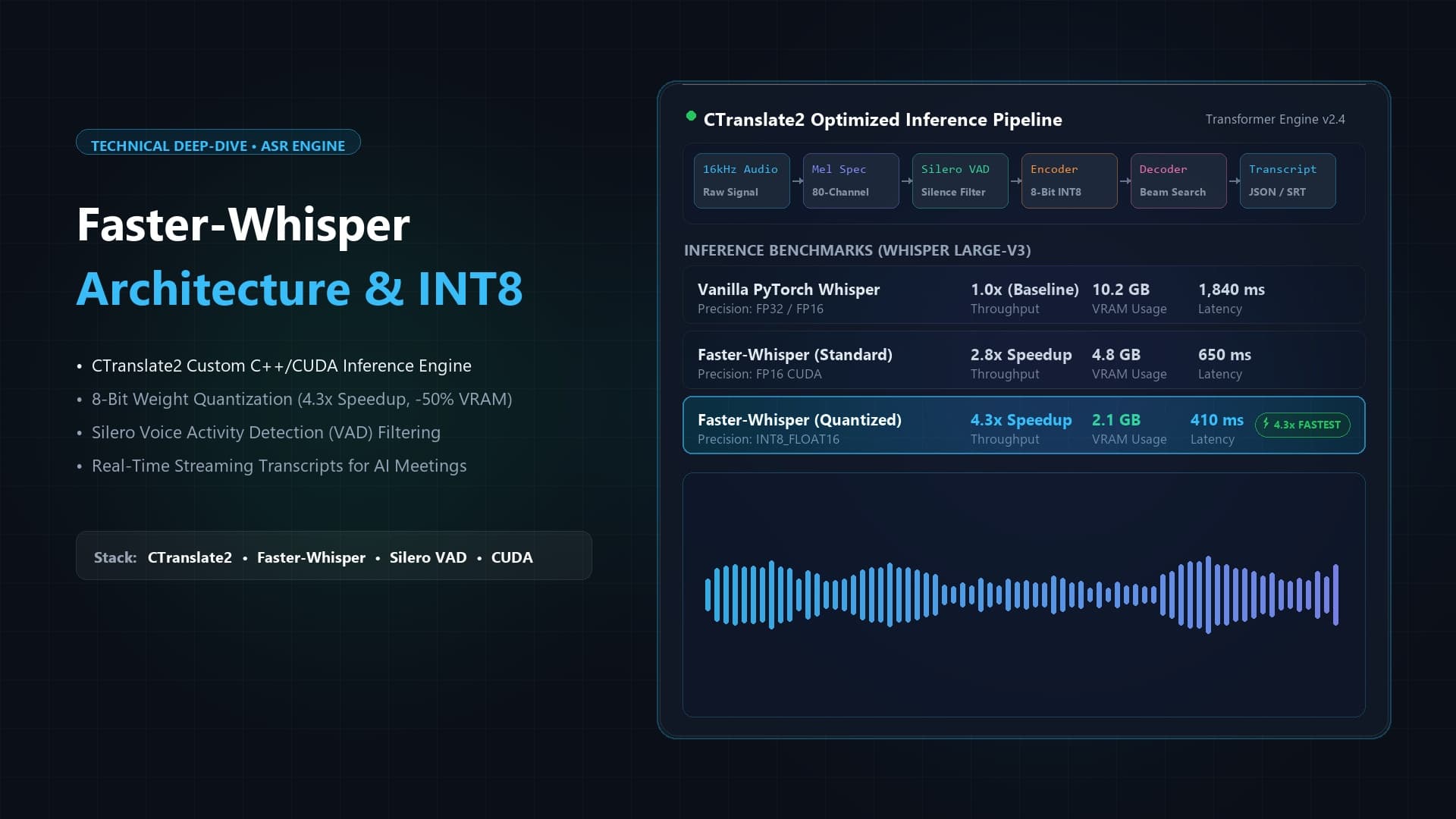
- Latency: Using optimized inference engines like
vLLMorfaster-whisper, an A10G can achieve an RTF of ~45x. - Cost: If the GPU operates at 90% utilization continuously, the cost plummets to ~$0.0015 per minute. However, factoring in idle time and queue management, blended costs often align closer to $0.003 per minute.
- Engineering Overhead: High. You must manage Docker containers, CUDA versions, GPU auto-scaling groups, and the complex Pyannote alignment logic.
5. How Modern AI Transcription Platforms Solve This
For platforms like MeetMind AI, choosing between these two approaches requires balancing accuracy, cost, and engineering velocity.
The Hybrid Routing Architecture
To optimize both cost and quality, modern platforms deploy a dynamic routing architecture:
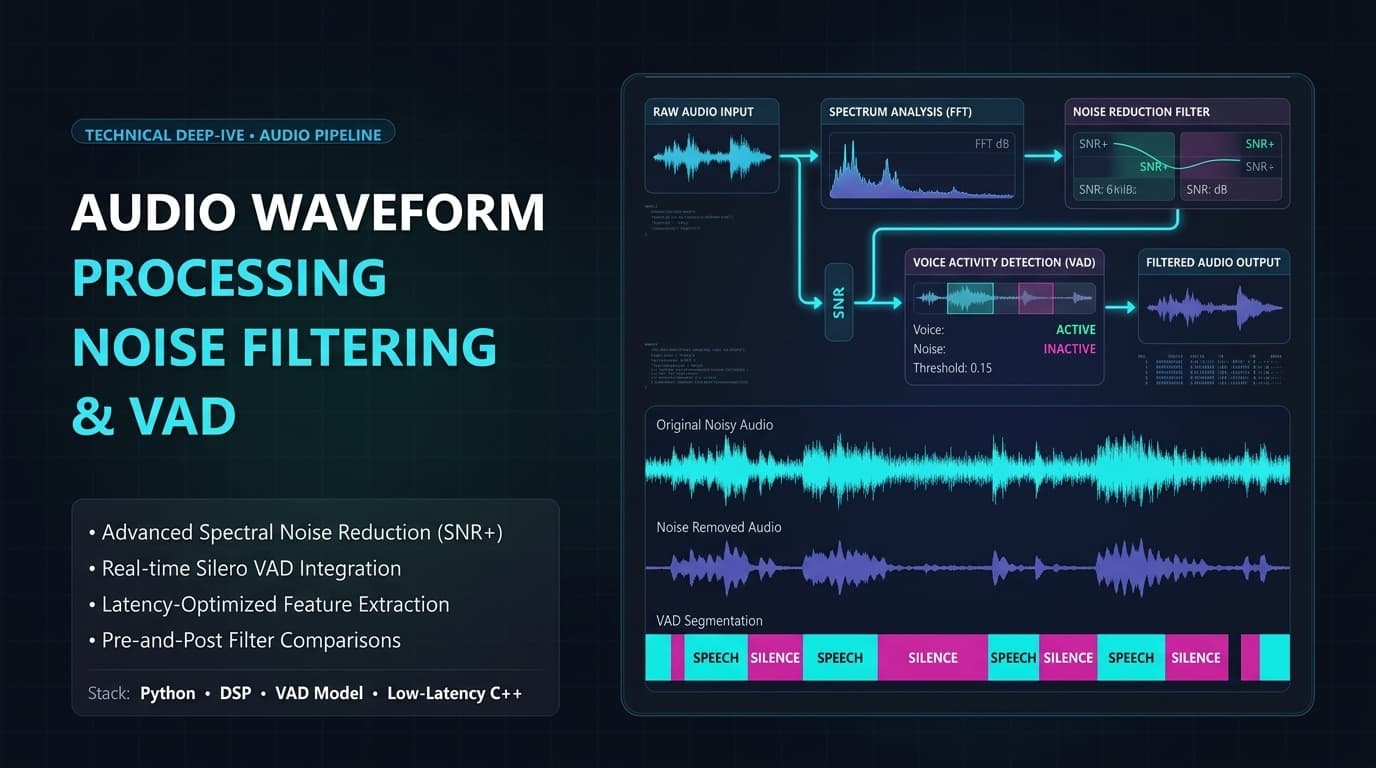
- Initial Audio Triage: When a meeting recording is uploaded, a lightweight model analyzes the audio SNR (Signal-to-Noise Ratio).
- High-Complexity Routing: If the audio contains heavy crosstalk or adversarial noise, the payload is routed to Deepgram Nova-3 to leverage its superior native diarization.
- Standard Routing: If the audio is a standard 1-on-1 Zoom call with clean separation, it is routed to an internal serverless GPU cluster running Whisper-large-v3-turbo, maximizing margin on easy tasks.
By dynamically routing based on acoustic complexity, platforms can maintain a sub-10% global WER while optimizing unit economics.
Frequently Asked Questions
Why does Whisper sometimes repeat the same sentence endlessly?
This is a known failure mode called the "hallucination loop." It occurs when Whisper encounters long stretches of silence or heavy noise, causing its autoregressive decoder to get stuck in a repetition loop. Pre-processing the audio with a strict VAD to remove silence entirely prevents this.
Can I use Deepgram for real-time streaming?
Yes. Unlike Whisper, which requires heavy modification for streaming, Deepgram provides a native WebSockets API that delivers interim transcripts with sub-300ms latency, making it the superior choice for live captioning.
Is Pyannote 3.1 free for commercial use?
While Pyannote is open-source, version 3.1 requires agreeing to specific licensing terms on HuggingFace, and deploying it commercially requires adherence to the model's user conditions. Always verify licensing before deploying open-weights in a commercial pipeline.
Which model is better for non-English languages?
Whisper-large-v3-turbo was trained on a massive multilingual dataset and generally outperforms Deepgram in zero-shot translation and transcribing low-resource languages. If your user base is highly international, Whisper remains the undeniable global standard.

Written by Abhishek
I created MeetMind AI to eliminate manual note-taking and ensure teams never lose critical decisions or action items after a call. All technical content is verified against our current codebase.
Read Founder ProfileReady to eliminate manual meeting notes?
Secure your meeting data while generating accurate AI summaries in minutes.
- AI Meeting Notes & Summaries
- Automated Action Item Tracking
- Search Across Every Meeting