Table of Contents
Executive Overview
When architecting a speech-to-text platform, the decision between deploying a real-time streaming pipeline or a batch transcription queue fundamentally shapes your infrastructure, user experience, and unit economics. Real-time pipelines excel in live assistance and immediate feedback loops but carry a 3x–5x infrastructure cost premium due to persistent compute requirements. Batch processing maximizes GPU utilization and drastically lowers cost, making it ideal for post-meeting analysis and massive historical archives.
This guide breaks down the architectural trade-offs, Word Error Rate (WER) disparities, and infrastructure costs associated with both paradigms, providing a blueprint for engineering teams building at scale.
1. The Core Paradigms: Streaming vs. Asynchronous Processing
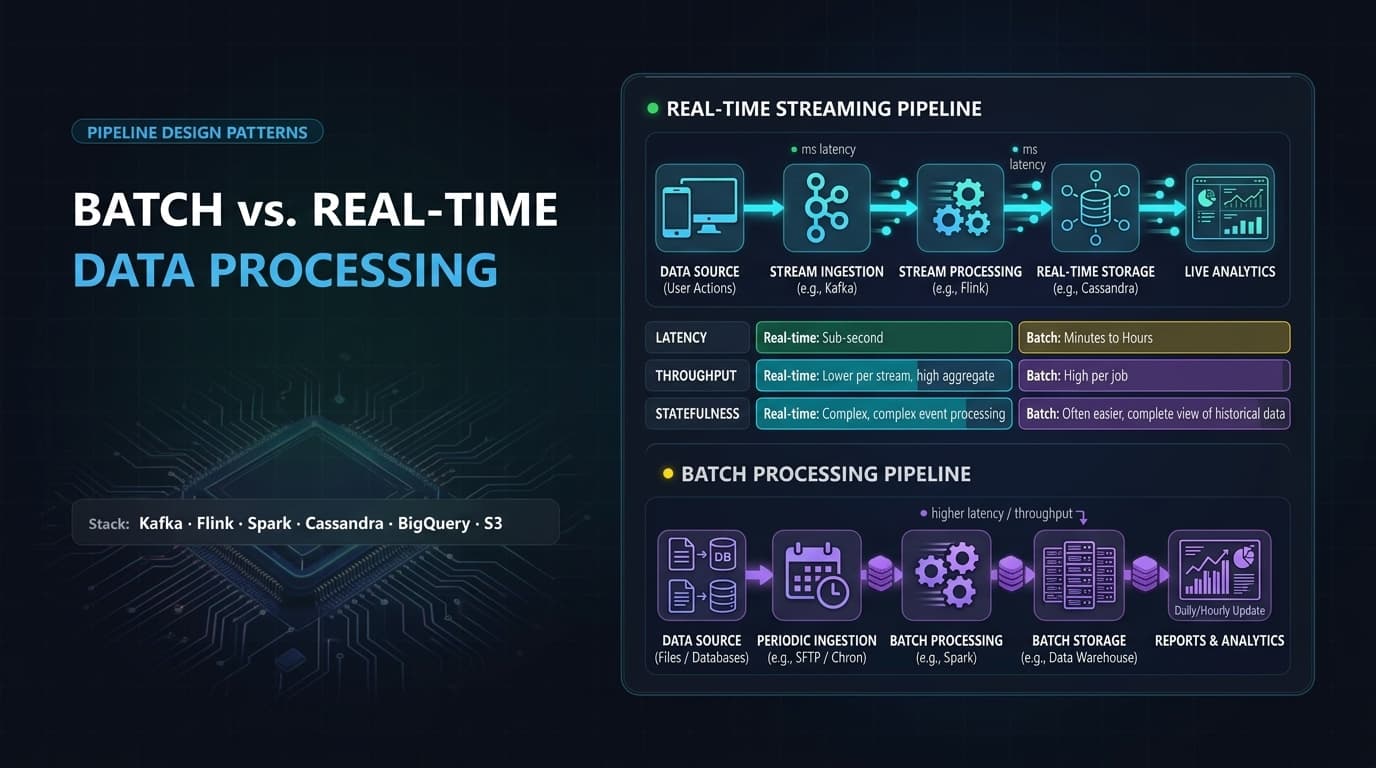
To understand the trade-offs, we must first look at how audio data moves through both architectures.
Real-Time Streaming Architecture
In a real-time system, audio is captured from the browser or application and chunked into tiny buffers (typically 20ms to 250ms). These buffers are streamed via WebSockets or gRPC bidirectional streams to an inference server.
- Ingestion: WebSockets keep a persistent stateful connection open between the client and the transcription server.
- Inference: The model continuously receives audio chunks. To maintain context, streaming models use a sliding window approach, recalculating the probable transcription as new phonemes arrive. This is why you often see text "flicker" or correct itself mid-sentence on live captions.
- Return: The server emits partial transcripts (interim results) and final transcripts (committed results) back down the socket.
Batch Processing Architecture
Batch systems operate asynchronously. The entire audio file is collected, uploaded, and processed as a single continuous block.
- Ingestion: Clients upload an audio payload (e.g., a
.mp4or.wavfile) to object storage (like AWS S3) via a signed URL. - Queueing: An event trigger pushes a message to a message broker (RabbitMQ, AWS SQS, Kafka).
- Inference: Worker nodes pick up the job, download the audio, run a monolithic inference pass (often leveraging aggressive batching algorithms), and write the JSON payload back to the database.
- Return: The client is notified via a Webhook or Server-Sent Events (SSE) that the transcription is complete.
2. Latency and User Experience
Latency is the most visible difference to the end user, but "latency" means different things depending on the pipeline.
Real-Time Latency Metrics
In streaming, we measure Time to First Word (TTFW) and Endpoint Latency (the time it takes for the system to commit a finalized sentence after the speaker pauses).
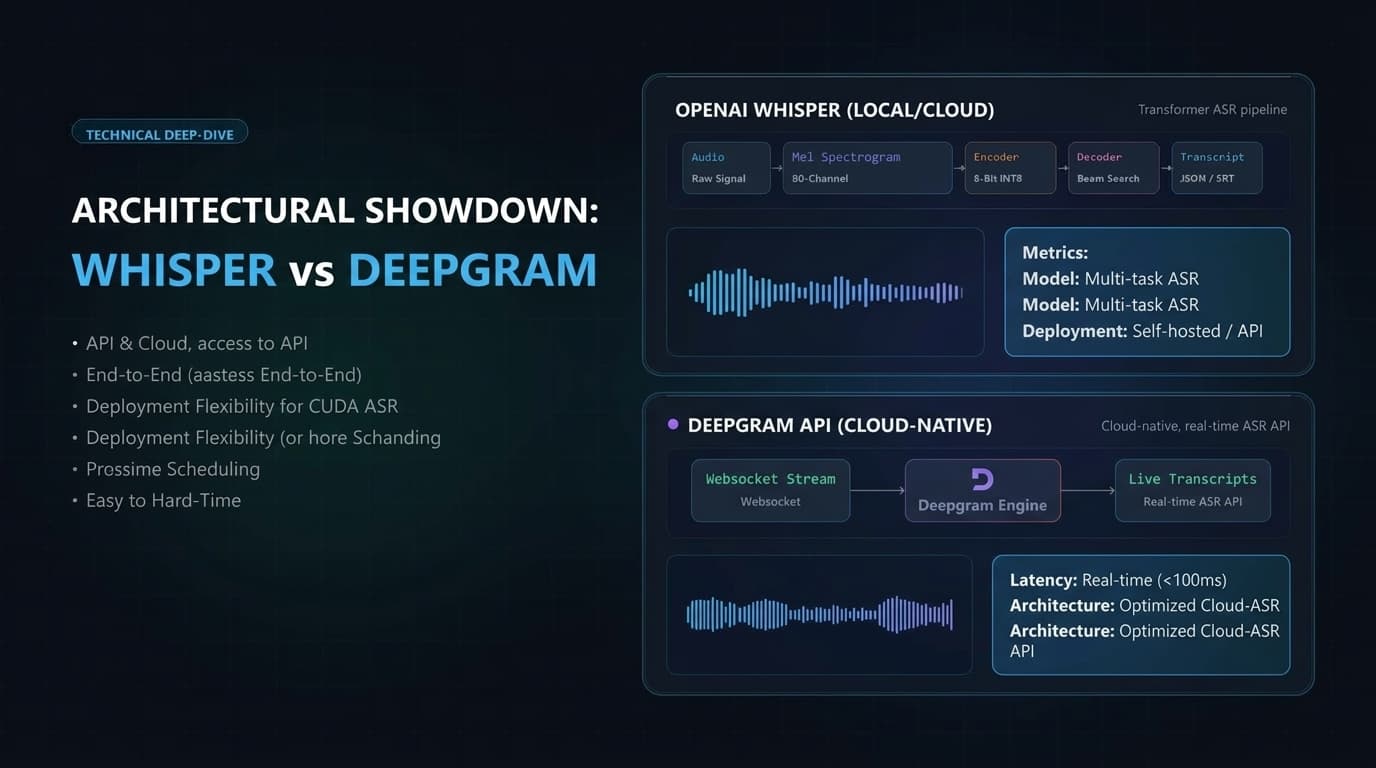
- State of the Art: Providers like Deepgram Nova-3 can achieve end-to-end streaming latency of <300ms. Whisper, traditionally a batch model, requires extensive modification (like Whisper.cpp or Whisper-streaming with chunked attention) to operate in real-time, often pushing latency to 1–2 seconds.
Batch Latency Metrics
In batch processing, we measure Turnaround Time (TAT) as a multiple of audio duration.
- State of the Art: A standard 60-minute meeting processed on an NVIDIA A100 GPU using Whisper-large-v3-turbo (with Flash Attention) can be transcribed in roughly 45 seconds to 1.5 minutes. This represents a ~40x real-time factor (RTF).
The Trade-off
If the user's workflow requires live intervention (e.g., a sales rep getting live coaching during a call), real-time is non-negotiable. However, if the goal is generating a summary or action items after a Zoom call concludes, batch processing delivers the result fast enough that the user experiences it as "instantaneous" upon ending the meeting.
3. GPU Utilization and Infrastructure Costs
The economic disparity between these two architectures is stark. The cost of running transcription at scale is entirely dictated by GPU utilization.
The Cost of Idle Time in Real-Time
In a live meeting, participants speak roughly 30% to 40% of the time. There are pauses, people listening, and silences. However, a real-time WebSocket connection requires a dedicated thread and persistent GPU VRAM allocation for the duration of the call.
Consider a scenario where you have 500 concurrent live meetings. You must provision compute infrastructure to maintain 500 concurrent bidirectional streams. Even if 300 of those speakers are completely silent at any given millisecond (because someone else is presenting), your GPU is still locked into maintaining state and holding weights in memory for those idle connections. This leads to horrific GPU underutilization.
When you price this out on cloud providers (e.g., AWS g5.2xlarge instances running NVIDIA A10G GPUs at roughly $1.21/hour), maintaining idle capacity to handle burst traffic in real-time pipelines can skyrocket your operational costs to upwards of $0.05 per transcribed minute.
Maximum Throughput in Batch
Batch processing treats GPU compute cycles as a highly optimized, fungible resource. You are never wasting compute on silence.
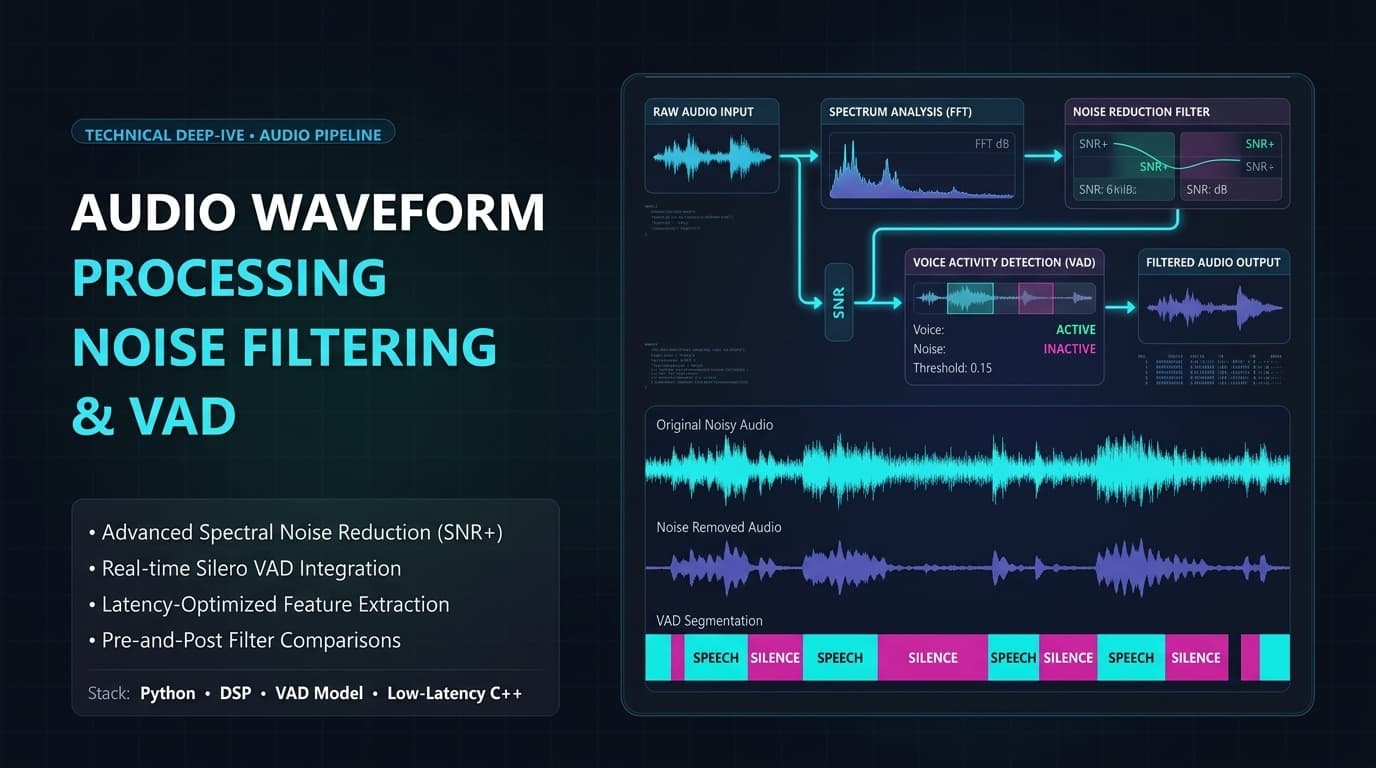
In a batch pipeline, the audio is first decoded and passed through a lightweight Voice Activity Detection (VAD) model to strip out all non-speech segments. The remaining dense audio is chunked into 30-second segments. These segments are packed tightly into the GPU's memory up to the maximum batch size (often 24 to 32 chunks simultaneously).
An A10G GPU that might struggle to handle 100 concurrent real-time streams without tail latency degradation can comfortably process thousands of minutes of batched audio per hour. Because the GPU is operating near 100% utilization during the job, the unit economics plummet. Running a managed batch transcription pipeline often costs less than $0.005 per minute—a 10x cost reduction compared to streaming.
| Metric | Real-Time Streaming | Batch Processing |
|---|---|---|
| Compute Paradigm | Always-on, persistent connection | Ephemeral, queue-based workers |
| GPU Utilization | Low (~20-40% due to conversational silence) | High (90%+ via dynamic batching) |
| Relative Cost | $$$ ($0.03 - $0.05 / min) | $ ($0.002 - $0.005 / min) |
| Infrastructure Scalability | Hard (requires connection draining, sticky sessions) | Easy (stateless workers reading from SQS) |
| Failure Handling | Complex (socket disconnects lose state) | Trivial (dead-letter queues, automatic retries) |
4. Accuracy and Word Error Rate (WER)
A common misconception is that real-time models are just as accurate as batch models. They are not.
Real-time models suffer from a fundamental disadvantage: lack of future context. When a human speaks, the meaning (and acoustic probability) of a word is heavily dependent on the words that come after it.
Batch models have access to the entire audio file. They use bidirectional attention mechanisms to look forward and backward in time, resolving acoustic ambiguities with high confidence. Streaming models must make a best guess based only on the past, leading to higher Word Error Rates (WER).
Benchmark Comparison (Conversational Audio)
- Deepgram Nova-3 (Batch): ~8.4% WER
- Deepgram Nova-3 (Streaming): ~10.1% WER
- Whisper-large-v3-turbo (Batch): ~9.2% WER
- Whisper (Hacked for Streaming): ~14.5% WER + significant hallucination risks.
5. How Modern AI Transcription Solves This
Modern transcription APIs like OpenAI's Whisper and Deepgram have introduced architectural innovations to bridge the gap between these two extremes, allowing engineers to build "perceived real-time" applications using batch infrastructure.
Deepgram's Interim Results Architecture
Deepgram tackles the streaming accuracy problem by emitting is_final: false (interim) transcripts immediately for low latency (often under 200ms). However, the engine quietly re-evaluates the transcript as more acoustic context arrives.
When the model detects a natural pause or punctuation, it emits an is_final: true transcript that actively corrects the previous interim guesses. This architectural choice gives the UI the "snappiness" and responsiveness of real-time streaming, with a committed accuracy approaching that of a batch process.
Whisper's Turbo Variants and "Micro-Batching"
OpenAI's Whisper model was strictly built as a 30-second chunk batch processor. To use Whisper in a low-latency environment, engineers utilize frameworks like Faster-Whisper combined with a technique called Voice Activity Detection (VAD) chunking (or Micro-batching).
The Micro-Batching Workflow:
- Client-Side VAD: A lightweight WebAssembly VAD (like Silero VAD) listens to the microphone stream directly inside the user's browser.
- Buffer Accumulation: While the user is speaking, the browser buffers the raw PCM audio data.
- Trigger Event: When the VAD detects a cessation of speech for 400ms (a natural pause), the buffer is immediately finalized, compressed (e.g., to Opus), and transmitted to the server via an HTTP POST request.
- Stateless Inference: The server treats this 3-5 second audio clip as a tiny batch job. It passes it to the Whisper API, which returns the transcript in ~300ms.
This hybrid approach completely circumvents the need for persistent WebSockets. The infrastructure is entirely stateless, scaling seamlessly on serverless container platforms (like AWS Fargate, Google Cloud Run, or Modal). It offers the cost and accuracy benefits of batch processing while simulating a real-time experience for the user.
Example Architecture Configuration
When setting up a micro-batching architecture, your worker nodes must aggressively batch incoming micro-requests. A typical Ray Serve or Triton Inference Server deployment configuration for this looks like:
# triton_model_config.pbtxt
name: "whisper-large-v3-turbo"
backend: "tensorrt"
max_batch_size: 32

dynamic_batching {
  preferred_batch_size: [ 8, 16, 32 ]
  max_queue_delay_microseconds: 50000 # 50ms wait time
}
By adding a max_queue_delay_microseconds of 50ms, the server waits just a fraction of a second to see if other concurrent users upload a micro-batch. If so, it processes them simultaneously on the GPU, driving utilization up and costs down without significantly impacting the user's perceived latency.
Frequently Asked Questions
Should I build my own Whisper infrastructure or use a managed API?
For batch processing, deploying faster-whisper on a serverless GPU platform (like RunPod or Modal) is highly cost-effective if you process more than 10,000 minutes a month. For real-time streaming, managing WebSockets, load balancers, and GPU memory fragmentation is a massive engineering burden; utilizing a managed API like Deepgram or AssemblyAI is almost always recommended.
How do I handle overlapping speech (diarization) in real-time?
Real-time diarization is notoriously difficult because speaker embeddings take time to stabilize. Most systems assign arbitrary "Speaker 1" and "Speaker 2" labels during the live stream, and then run a secondary, highly accurate batch diarization pass once the meeting ends to correct the labels.
Why does my streaming transcript hallucinate during silence?
If you are streaming continuous audio without a VAD filter, background noise (fans, typing) can trigger the transformer model to "guess" words, leading to hallucinations. Always run a local VAD filter on the client-side to pause the data stream during true silence, saving bandwidth and preventing hallucinations.
What is the most cost-effective architecture for a meeting summarization app?
A strict asynchronous batch pipeline. Have the client application record locally, compress the audio (e.g., Opus/Ogg at 16kbps), and upload it to an S3 bucket at the end of the meeting. Trigger a serverless GPU worker to transcribe the audio, feed the text to an LLM (like Llama 3 or Claude) for summarization, and push the final JSON via WebSockets to the user's dashboard.

Written by Abhishek
I created MeetMind AI to eliminate manual note-taking and ensure teams never lose critical decisions or action items after a call. All technical content is verified against our current codebase.
Read Founder ProfileReady to eliminate manual meeting notes?
Secure your meeting data while generating accurate AI summaries in minutes.
- AI Meeting Notes & Summaries
- Automated Action Item Tracking
- Search Across Every Meeting