Table of Contents
Modern Automatic Speech Recognition (ASR) has shifted from classical Hidden Markov Models (HMM) to end-to-end deep learning architectures. This guide breaks down the data flow, acoustic feature extraction, and sequence-to-sequence decoding that answers exactly how AI transcription works in production.
1. The Audio Processing Pipeline
Before neural networks can interpret speech, raw audio waves must be transformed into a format suitable for spatial and temporal pattern recognition.
Signal Ingestion and Pre-Processing
Audio is ingested and converted to a mono channel. The signal is then framed into overlapping windows (e.g., 25ms windows with a 10ms shift) to capture the time-varying nature of speech.
In production systems, preprocessing also handles file compression. For example, if an uploaded recording exceeds standard API size thresholds (such as 24MB) or uses non-standard codecs, an automated pre-processor extracts mono audio at a 16 kbps bitrate via ffmpeg (-ac 1 -b:a 16k) to minimize payload size before submitting audio to downstream speech models:
# Codebase Pattern: FFmpeg Audio Compression Pre-processor
import os
import subprocess
import imageio_ffmpeg

def compress_if_needed(file_path: str) -> str:
    """Extracts mono MP3 audio at 16 kbps bitrate (-ac 1 -b:a 16k) to optimize API bandwidth."""
    file_size_mb = os.path.getsize(file_path) / (1024 * 1024)
    ext = os.path.splitext(file_path)[1].lower()

    # Native lightweight formats under threshold bypass conversion
    if ext in {".mp3", ".wav", ".m4a", ".webm"} and file_size_mb < 24.0:
        return file_path


    compressed_path = file_path + "_compressed.mp3"
    ffmpeg_exe = imageio_ffmpeg.get_ffmpeg_exe()
    subprocess.run(
        [ffmpeg_exe, "-y", "-i", file_path, "-vn", "-ac", "1", "-b:a", "16k", compressed_path],
        stdout=subprocess.DEVNULL, stderr=subprocess.DEVNULL, check=True
    )
    return compressed_path
Mel-Spectrogram Extraction
The core of modern ASR feature extraction relies on mapping audio frequencies to human auditory perception scales.
| Pipeline Stage | Transformation | Output Shape (Approx) | Purpose |
|---|---|---|---|
| STFT | Short-Time Fourier Transform | (N_frames, Frequency_bins) | Converts time-domain to frequency-domain |
| Mel Filterbank | Mel-Scale Mapping | (N_frames, 80) | Maps frequencies to human hearing ranges |
| Log-Scaling | Logarithmic Compression | (N_frames, 80) | Compresses dynamic range for stable gradients |
This output matrix, the log-Mel spectrogram, is the actual input tensor fed into neural network acoustic encoders.
2. Transformer-Based ASR Architecture (Whisper Model)
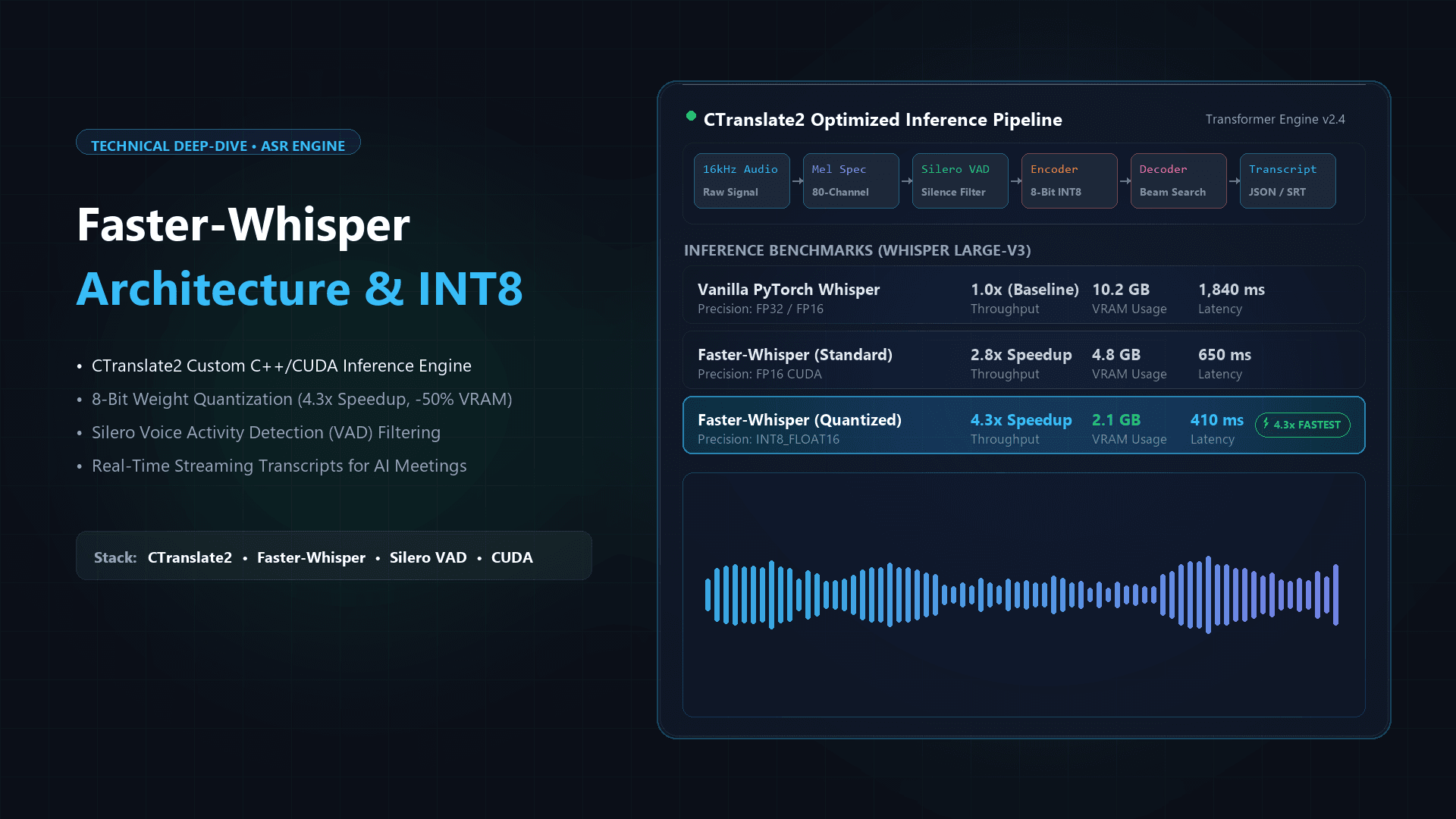
Systems like OpenAI's Whisper utilize a standard Encoder-Decoder Transformer architecture.
The Encoder: Acoustic Representation
The encoder ingests the (N_frames, 80) spectrogram tensor. It typically employs two 1D Convolutional layers to sub-sample the sequence and capture local temporal relationships.
The output is processed through a stack of Transformer Encoder blocks (Self-Attention + Feed-Forward Networks). Each block computes a contextualized representation of the audio frame, allowing the model to understand acoustic features in the context of the entire utterance.
The Decoder: Sequence Generation
The decoder autoregressively predicts the text sequence, token by token. It relies on two attention mechanisms:
- Masked Self-Attention: Attends to previously generated text tokens.
- Cross-Attention: Attends to the encoder's acoustic representations, aligning text generation with specific audio frames.
3. Production ASR Orchestration & Multi-Model Routing
Deploying ASR in production requires balancing latency, cost, and speaker identification accuracy (diarization). Modern applications often route incoming audio dynamically based on the requested processing mode:
# Codebase Pattern: Production ASR Routing Orchestrator
import os
import httpx
from openai import OpenAI

def process_transcript(file_path: str, mode: str = "fast") -> dict:
    """
    Orchestrates transcription requests:
    - mode='fast': Uses Groq API (whisper-large-v3-turbo) for high-speed word timestamps.
    - mode='meeting': Uses Deepgram API (nova-3) for speaker diarization.
    """
    if mode == "meeting":
        # Deepgram nova-3 endpoint with diarization enabled
        url = "https://api.deepgram.com/v1/listen?model=nova-3&smart_format=true&diarize=true"
        headers = {"Authorization": f"Token {os.getenv('DEEPGRAM_API_KEY')}"}
        with open(file_path, "rb") as audio:
            with httpx.Client(timeout=180.0) as client:
                res = client.post(url, headers=headers, content=audio)
                return res.json()
    else:
        # Groq whisper-large-v3-turbo endpoint
        client = OpenAI(api_key=os.getenv("GROQ_API_KEY"), base_url="https://api.groq.com/openai/v1")
        with open(file_path, "rb") as audio:
            return client.audio.transcriptions.create(
                file=(os.path.basename(file_path), audio),
                model="whisper-large-v3-turbo",
                response_format="verbose_json"
            )
Architectural Trade-offs in Production
| Dimension | Fast Mode (whisper-large-v3-turbo) | Meeting Diarization Mode (nova-3) |
|---|---|---|
| Primary Focus | Maximum processing speed & word timestamps | Speaker diarization (e.g. Speaker 1, Speaker 2) |
| Speaker Isolation | Single stream transcript without speaker labels | Grouped speaker turns with timing bounds |
| Fallback Behavior | Primary fast route; fails over to Deepgram | Primary meeting route; fails over to Groq if diarization errors occur |
| Primary Use Case | 1-on-1 audio memos & solo dictations | Multi-person syncs, panel discussions, client calls |
The Evolution of Speech to Text
Modern transcription models have revolutionized accessibility and record-keeping. With models like Whisper-large-v3-turbo processing audio at unprecedented speeds, high-fidelity transcription is now an operational baseline for modern businesses.

Written by Abhishek
I created MeetMind AI to eliminate manual note-taking and ensure teams never lose critical decisions or action items after a call. All technical content is verified against our current codebase.
Read Founder ProfileReady to eliminate manual meeting notes?
Secure your meeting data while generating accurate AI summaries in minutes.
- AI Meeting Notes & Summaries
- Automated Action Item Tracking
- Search Across Every Meeting