Table of Contents
Voice Artificial Intelligence (Voice AI) is no longer just about converting speech to text. The modern Voice AI ecosystem integrates multiple deep learning models to transcribe, analyze, and extract useful information from spoken conversations.
While legacy systems relied on basic acoustic matching, modern platforms use complex pipelines combining Automatic Speech Recognition (ASR), Speaker Diarization, and Natural Language Processing (NLP) to extract meaningful insights from raw audio.
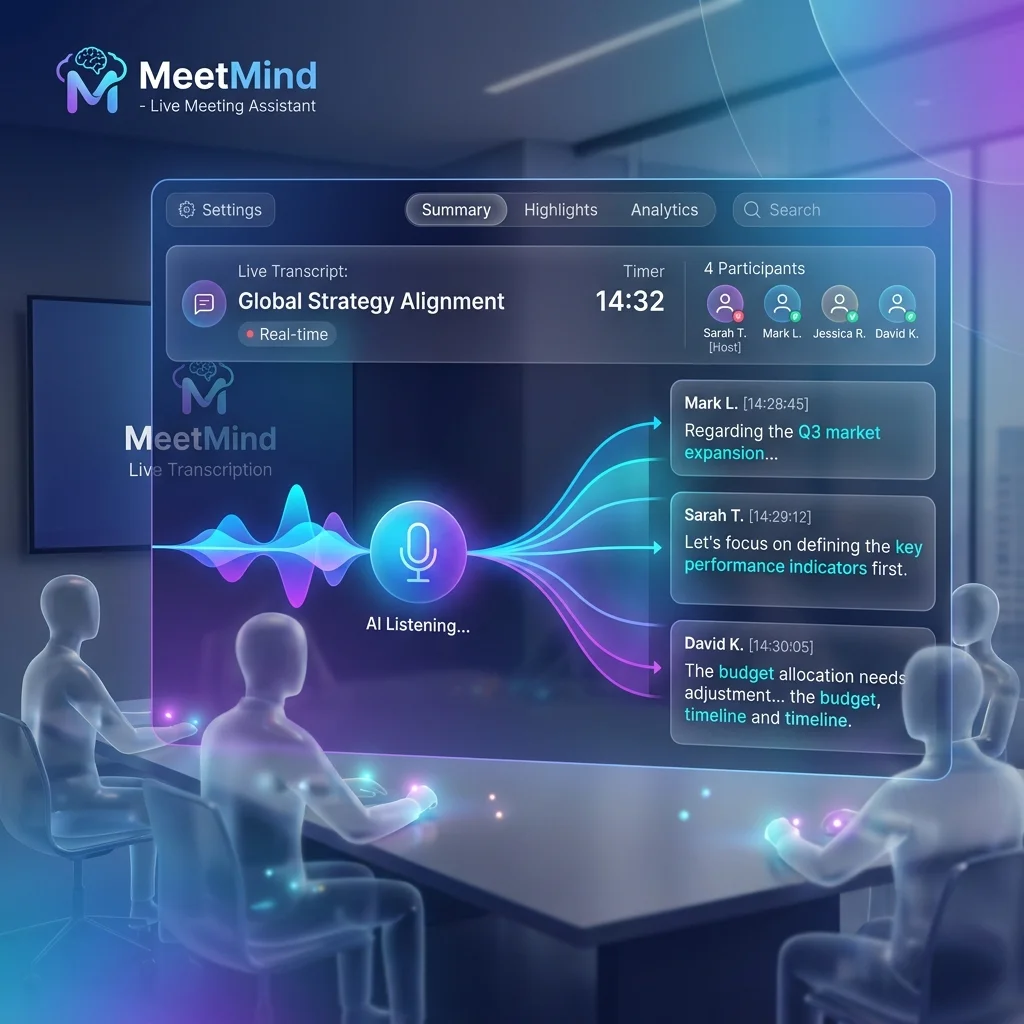
This guide breaks down the core components of Voice AI and explains how they interact to power tools like MeetMind AI.
| Component | Purpose | Output |
|---|---|---|
| ASR | Converts speech into text | Transcript |
| Speaker Diarization | Separates speakers | Speaker labels |
| NLP | Understands meaning | Summary, action items |
| TTS | Converts text into speech | Spoken responses |
1. Automatic Speech Recognition (ASR)
ASR is the foundation of Voice AI, responsible for converting audio signals into raw text. Modern ASR relies heavily on transformer-based architectures rather than older Hidden Markov Models.
- Acoustic Processing: Audio waves are converted into spectrograms, allowing neural networks to analyze frequency patterns over time.
- Sequence Decoding: Models like OpenAI's Whisper use encoder-decoder setups. The encoder processes the audio features, while the decoder predicts the correct sequence of text tokens.
- Contextual Understanding: Unlike older dictation software that struggled with homophones (e.g., "their" vs. "there"), modern ASR uses the surrounding textual context to determine the correct word.
For a deep dive into the specific mechanics of modern transcription models, read our guide on How AI Transcription Works.
2. Speaker Diarization: "Who Spoke When?"
Transcription alone is insufficient for multi-participant environments like remote meetings. If you simply transcribe an hour of audio, you get a massive block of text with no attribution.
Speaker diarization solves this by segmenting the audio track and assigning a unique label to each distinct voice.
The Diarization Pipeline
- Voice Activity Detection (VAD): The system first identifies segments where speech is actively occurring, stripping out silence or background noise.
- Audio Embedding Extraction: The spoken segments are passed through an embedding model (such as x-vectors or ECAPA-TDNN). This model maps the unique acoustic characteristics of a voice (pitch, cadence, timbre) into a high-dimensional vector space.
- Clustering: Algorithms like Agglomerative Hierarchical Clustering group these vectors. Vectors that are close together in the vector space belong to the same speaker.
- Label Assignment: The system assigns generic labels (Speaker A, Speaker B) to the clusters and maps them back to the transcription timestamps.
Accurate speaker diarization helps downstream NLP systems associate decisions, commitments, and action items with the correct participant.
3. Natural Language Processing (NLP) and Understanding
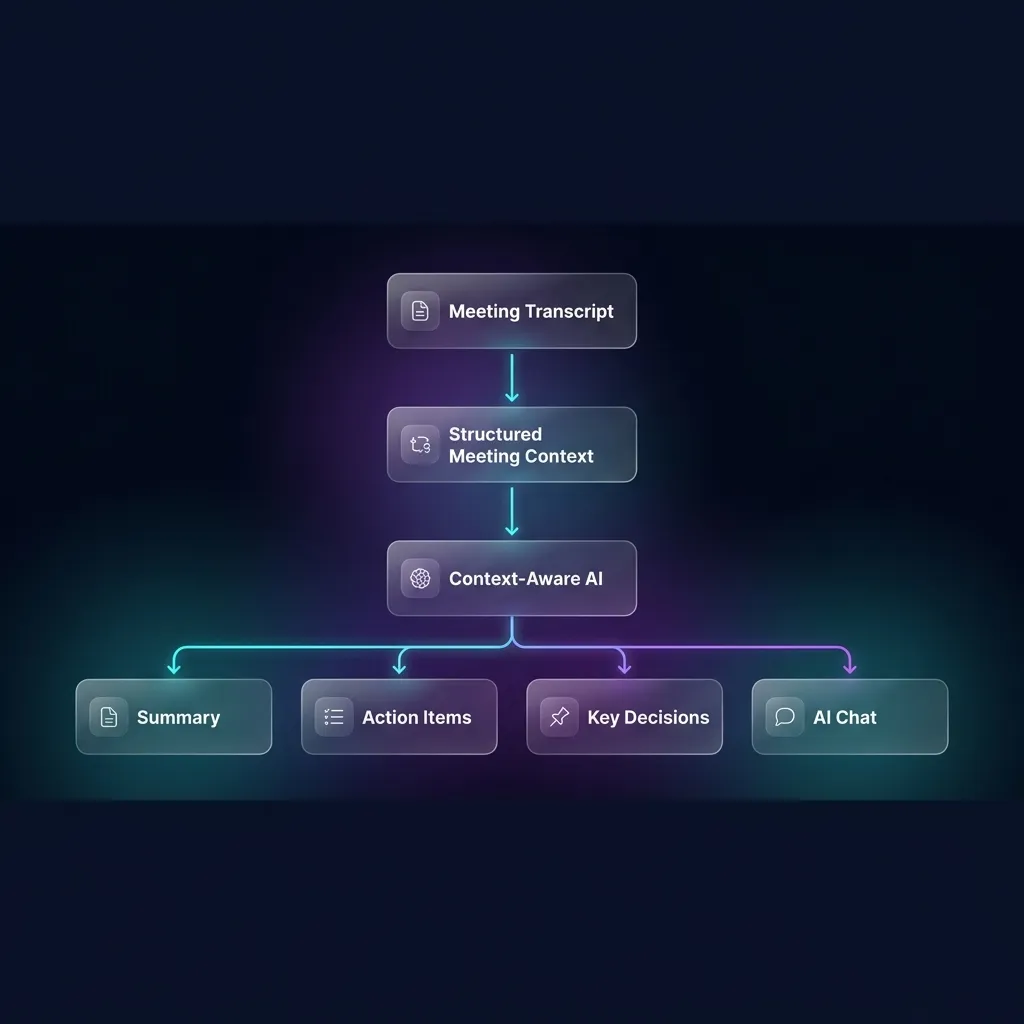
Once Voice AI has generated an accurately diarized transcript, large language models (LLMs) take over to provide actual utility. Raw transcripts are notoriously difficult to read because spoken language is filled with filler words, false starts, and tangents.
Modern Voice AI systems use NLP to perform:
- Abstractive Summarization: Instead of just extracting key sentences, the model rewrites the core discussion points into a concise, readable format.
- Action Item Extraction: By analyzing verbs and commitments (e.g., "I'll send the report by Friday"), the NLP model isolates actionable tasks and assigns them based on the diarization labels.
- Sentiment and Tone Analysis: Depending on the application, NLP models may also estimate conversation sentiment, urgency, or agreement to provide additional context.
This is the exact pipeline MeetMind AI uses to turn meeting transcripts into action items.
4. Voice Generation (TTS and Conversational Agents)
The final pillar of Voice AI, though less common in meeting transcription, is Text-to-Speech (TTS). Modern TTS models synthesize highly realistic, expressive audio from text.
When you combine ASR (listening), NLP (thinking), and TTS (speaking), you create fully autonomous conversational agents capable of interacting with users in real-time. Context-aware conversational systems build on these same Voice AI foundations. While MeetMind AI focuses on passive observation and summarization during meetings, the underlying technology stack is identical to what powers voice-based customer service bots or virtual assistants.
The Workflow Impact
The integration of these Voice AI components has shifted the technology from a simple accessibility feature (dictation) to a core productivity driver. By automating the capture and structuring of verbal communication, teams can focus on the actual discussion rather than the administrative overhead of documentation.
Understanding how Voice AI components interlock is crucial for selecting the right tools for your organization, particularly when evaluating requirements around privacy, latency, and integrations with platforms like Zoom, Google Meet, or Microsoft Teams.
FAQ
Is Voice AI the same as speech-to-text?
No. Speech-to-text is only one part of Voice AI. Modern Voice AI systems combine transcription, speaker identification, language understanding, and sometimes speech synthesis.
What is speaker diarization?
Speaker diarization identifies when different people are speaking and labels their contributions throughout a conversation.
Why is Voice AI useful for meetings?
Voice AI can organize long conversations into searchable transcripts, summaries, and structured action items, making meetings easier to review and follow up.
Conclusion
Voice AI is no longer a single technology but a collection of specialized AI systems working together. Automatic speech recognition converts speech into text, speaker diarization identifies participants, NLP extracts meaning, and optional speech synthesis enables conversational responses. Understanding these components helps organizations evaluate Voice AI tools based on accuracy, privacy, workflow fit, and operational requirements rather than marketing claims alone.
Ready to eliminate manual meeting notes?
Secure your meeting data while generating accurate AI summaries in minutes.
- AI Meeting Notes & Summaries
- Automated Action Item Tracking
- Search Across Every Meeting