Table of Contents
When OpenAI introduced the Whisper model family, it transformed Automatic Speech Recognition (ASR) by delivering robust multilingual transcription trained on 680,000 hours of diverse audio. However, deploying vanilla PyTorch Whisper in production environments introduces latency and infrastructure bottlenecks: high GPU VRAM footprints, high compute costs, and slow autoregressive decoding.
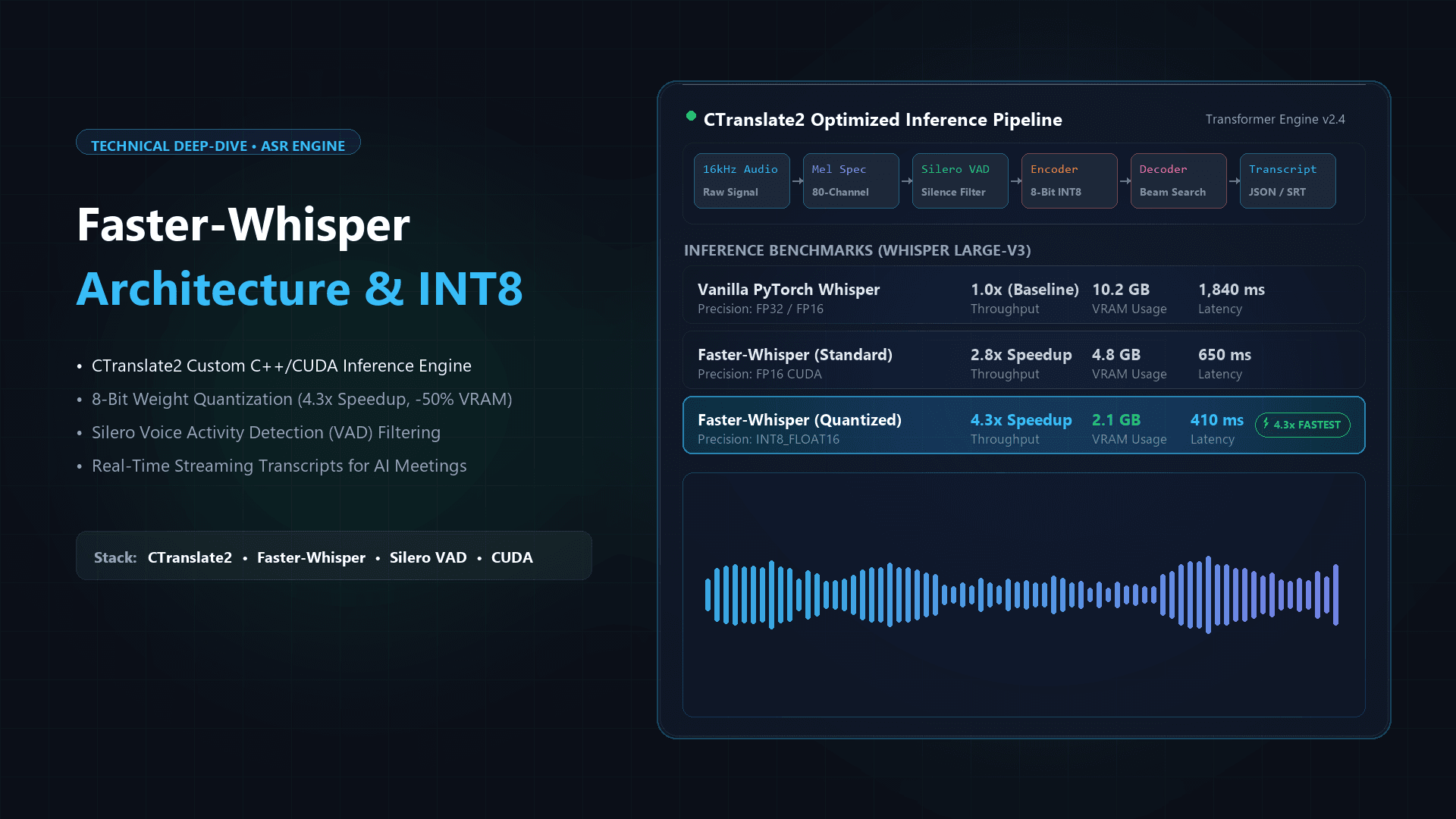
Faster-Whisper addresses this computational bottleneck. By reimplementing OpenAI's Whisper model on top of CTranslate2—a fast inference engine for Transformer models written in custom C++ and CUDA—Faster-Whisper significantly accelerates inference while cutting memory consumption.
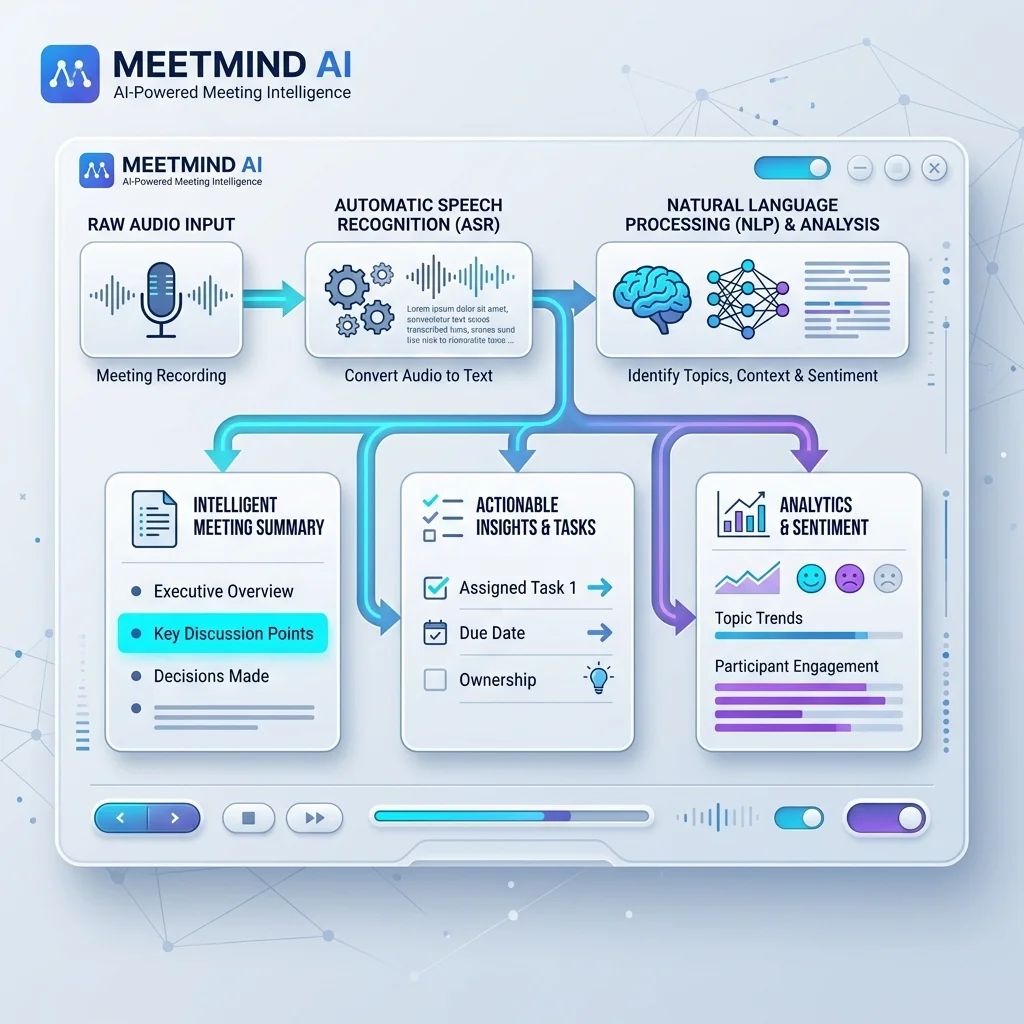
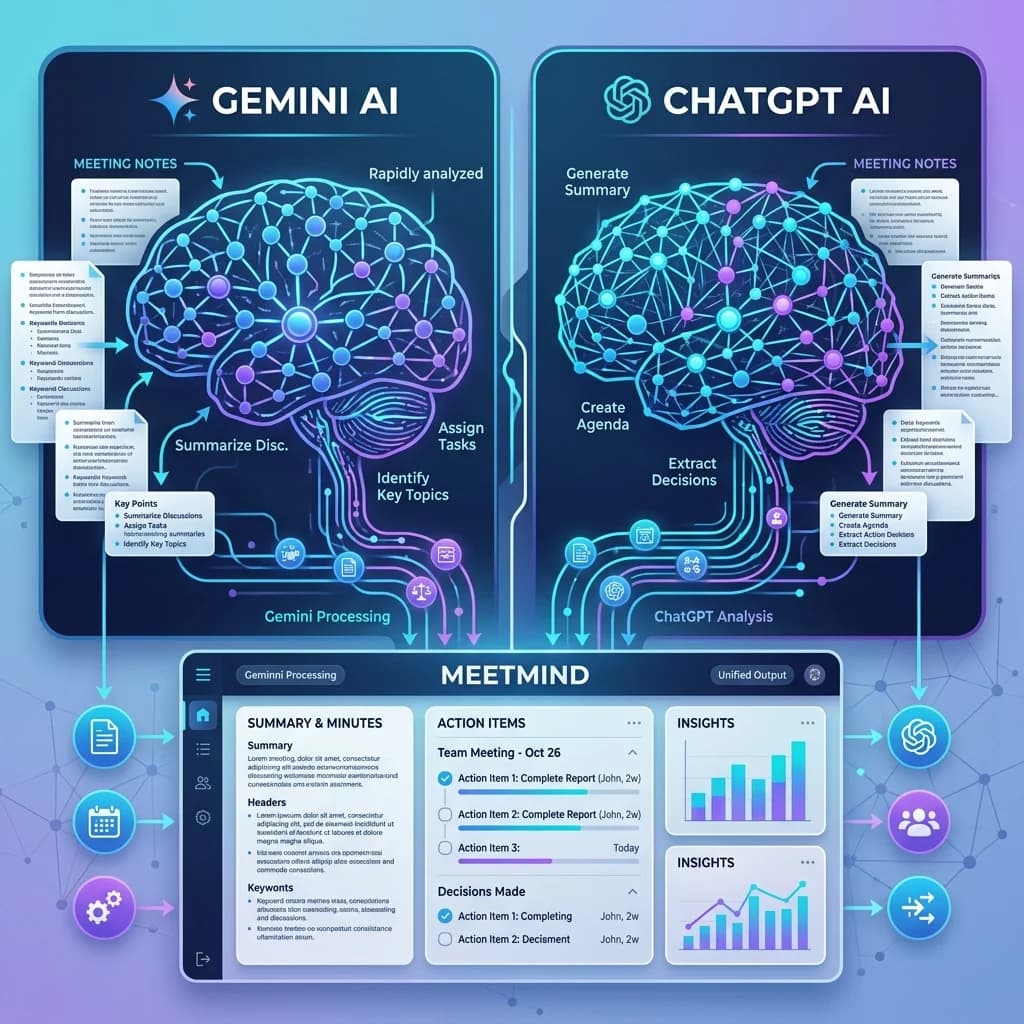
Architectural Context: MeetMind AI publishes this guide as an educational breakdown of open-source ASR runtimes. In our production pipeline, MeetMind AI utilizes managed commercial cloud APIs (Groq Whisper Large v3 Turbo and Deepgram Nova-3) rather than self-hosting Faster-Whisper instances, maximizing processing speed and eliminating client hardware strain.
1. What is Faster-Whisper? The CTranslate2 Advantage
Vanilla Whisper relies on Python and standard PyTorch runtimes. While PyTorch is exceptional for model training and rapid experimentation, it incurs significant overhead during autoregressive inference due to Python GIL contention, dynamic memory allocation, and un-fused operator calls.
Faster-Whisper replaces the PyTorch execution backend with CTranslate2, an open-source inference library designed specifically for Transformer architectures. CTranslate2 achieves hardware efficiency through several low-level engineering optimizations:
- Operator Fusion: Multiple consecutive neural operations (such as LayerNorm, Matrix Multiplication, and Bias Addition) are fused into unified CUDA kernels, minimizing memory bandwidth round-trips.
- Custom GEMM Implementations: CTranslate2 leverages tuned General Matrix Multiplication (GEMM) libraries, including NVIDIA cuBLAS, TensorRT kernels, and Intel oneDNN.
- Static Memory Allocation & Arena Pooling: Instead of continuously allocating and freeing tensors during beam search, CTranslate2 pre-allocates unified memory arenas, avoiding memory fragmentation and runtime latency spikes.
- Aggressive Quantization Support: Native execution of 8-bit integer (
int8), 8-bit float (float8), and mixed precision (int8_float16) tensor calculations.
+-------------------------------------------------------------------+
|                        Faster-Whisper Pipeline                    |
|                                                                   |
|  [Raw Audio Stream] ---> [Silero VAD Filter]                     |
|                                 |                                 |
|                                 v                                 |
|                     [80-Channel Mel Spectrogram]                  |
|                                 |                                 |
|                                 v                                 |
|                     [CTranslate2 Audio Encoder]                   |
|                        (Quantized INT8/FP16)                      |
|                                 |                                 |
|                                 v                                 |
|                     [Autoregressive Text Decoder]                 |
|                    + Key-Value Cache Optimization                 |
|                                 |                                 |
|                                 v                                 |
|             [Word-Level Timestamps & Confidence Scores]           |
+-------------------------------------------------------------------+
2. Neural Architecture: From Raw Audio to Tokens
To understand how Faster-Whisper accelerates inference, it helps to examine the underlying Whisper Transformer topology:
1. Audio Preprocessing
The incoming audio signal is resampled to 16 kHz mono and transformed into an 80-channel log-magnitude Mel spectrogram using a 25ms Hann window with a 10ms hop size:
Mel(f) = 2595 * log10(1 + f / 700)
2. The Encoder
The spectrogram is processed by two convolutional 1D layers with a filter width of 3 and a stride of 2, reducing the temporal resolution by a factor of 2. The output is augmented with learned 1D sinusoidal positional embeddings and fed into a series of standard Transformer encoder blocks containing Multi-Head Self-Attention and GELU feed-forward networks.
3. The Decoder
The decoder is an autoregressive Transformer decoder. It receives previously generated text tokens, applies causal self-attention, and computes cross-attention over the encoder output representations:
Attention(Q, K, V) = softmax((Q * K^T) / sqrt(d_k)) * V
In Faster-Whisper, the cross-attention Key (K) and Value (V) projections are computed once per audio chunk and stored in an optimized memory buffer, preventing redundant encoder re-evaluations during autoregressive token emission.
3. Quantization and Architectural Trade-Offs
Quantization maps continuous 32-bit or 16-bit floating-point weights into compact 8-bit integer domains. This reduces memory footprint and enables execution on dedicated integer tensor cores (such as NVIDIA INT8 Tensor Cores).
In uniform linear quantization, a floating-point value x is quantized to integer q via scale factor S and zero-point Z:
q = clip(round(x / S) + Z, -128, 127)
Published Characteristics: Vanilla vs. Faster-Whisper Runtimes
Published benchmarks vary by hardware, model size, quantization mode, and operational workload.
According to published documentation from the open-source SYSTRAN/faster-whisper project and CTranslate2 reference implementations, the primary trade-offs between execution backends include:
| Architectural Metric | Vanilla PyTorch Whisper | Faster-Whisper (CTranslate2 FP16) | Faster-Whisper (INT8 Quantized) |
|---|---|---|---|
| Execution Engine | PyTorch / Python C++ | CTranslate2 Custom CUDA / C++ Kernels | CTranslate2 INT8 Tensor Core Kernels |
| Relative Memory Footprint | Baseline (100%) | ~50% of baseline VRAM | ~30%–40% of baseline VRAM |
| Inference Throughput | Baseline (1x) | Up to ~2x–3x speedup on GPU | Up to ~4x speedup on supported hardware |
| Word Error Rate (WER) Impact | Reference Baseline | Statistically identical to baseline | Negligible variance (<0.1% WER delta on standard corpora) |
| Hardware Suitability | High-end GPUs with ample VRAM | Mid-range GPUs | Edge devices, CPU-only servers, and budget cloud GPUs |
4. Voice Activity Detection (VAD) & Segmentation
One of the greatest challenges in processing raw meeting audio is the presence of prolonged silences, typing sounds, background coughing, and overlapping chatter. Standard Whisper processes fixed 30-second windows regardless of whether anyone is speaking, leading to two severe issues:
- Wasted Compute: The GPU spends cycles decoding empty background noise.
- Hallucination Cascades: When forced to decode silence, Whisper's autoregressive decoder often hallucinates phantom phrases (such as "Thank you for watching" or repetitive subtitle tags).
Faster-Whisper mitigates this by integrating a high-performance Silero VAD pre-filter.
[Raw Audio Track]
  │
  ├── Silero VAD Analysis (30ms frames)
  │     ├── Detect Speech Probabilities
  │     └── Mark Timestamp Boundaries [t_start, t_end]
  │
  ├── Filter Non-Speech Regions (Silence / Noise > 500ms)
  │
  └── Batch Valid Speech Segments -> [Faster-Whisper Decoder]
By dynamic chunking, Faster-Whisper only runs the heavy Transformer encoder-decoder over active voice segments, trimming overall processing latency substantially on standard meeting recordings.
5. Preventing Hallucinations & Infinite Decoding Loops
In real-world meeting transcripts, acoustic degradation or cross-talk can cause autoregressive decoders to enter infinite repetition loops (e.g., repeating the same sentence multiple times). Faster-Whisper implements robust heuristics to maximize transcript fidelity:
- Temperature Fallback: The model initially samples at temperature T = 0.0 (greedy decoding). If the repetition penalty threshold or log-probability score fails a confidence check, the decoder falls back sequentially to T = [0.2, 0.4, 0.6, 0.8, 1.0].
- Repetition Penalty: Penalizes candidate tokens that have already appeared in the recent generation window.
- No-Speech Threshold: If the predicted probability P(no_speech) is high and average log-probability is low, the segment is immediately skipped rather than decoded.
To learn more about keeping confidential meeting data safe and private, read our guide on Local AI Transcription Privacy or follow our engineering guide on Speech-to-Text Audio Preprocessing.
6. Cloud APIs vs. Self-Hosted Deployment
While Faster-Whisper is exceptional for self-hosted and on-premises processing, managing GPU infrastructure at scale requires continuous operational maintenance, driver updates, and queue orchestration.
At MeetMind AI, our production architecture utilizes managed commercial APIs:
- Acoustic Transcoding: Multi-format audio is pre-processed and normalized to 16 kHz mono.
- Inference Pipeline: We utilize Groq's LPU inference engine running
whisper-large-v3-turbofor sub-second single-speaker transcription, and Deepgram's Nova-3 models when conversational speaker diarization is required. - Structured Synthesis: Transcripts are streamed to high-reasoning LLMs (such as Llama 3.3 via Groq or NVIDIA NIM) to extract actionable summaries, task assignments, and key decisions.
For practical execution workflows on how to route these summaries into issue trackers, review our Workflow Automation Guide and How MeetMind AI Works.
Conclusion
Faster-Whisper demonstrates how algorithmic profiling, CTranslate2 custom kernels, and 8-bit quantization can transform a computationally heavy research model into an efficient, production-ready speech engine.
Whether an engineering team chooses to self-host Faster-Whisper or leverage managed cloud endpoints like Groq and Deepgram, understanding the underlying acoustic signal chain and decoder constraints remains essential for building reliable speech intelligence systems.

Written by Abhishek
I created MeetMind AI to eliminate manual note-taking and ensure teams never lose critical decisions or action items after a call. All technical content is verified against our current codebase.
Read Founder ProfileReady to eliminate manual meeting notes?
Secure your meeting data while generating accurate AI summaries in minutes.
- AI Meeting Notes & Summaries
- Automated Action Item Tracking
- Search Across Every Meeting