Table of Contents
Executive Overview
Transcribing a meeting is a solved problem. The real engineering challenge lies in the semantic layer: extracting reliable, deterministic, and highly structured action items from the chaotic, unstructured reality of human conversation.
Generic prompts like "extract the action items" inevitably fail at scale. They capture vague intentions, miss explicit deadlines, and fail to resolve pronouns (e.g., "I'll do it" becomes useless without speaker mapping).
This guide provides a comprehensive blueprint for architecting an enterprise-grade action item extraction pipeline. We cover the foundational architecture, advanced prompt engineering techniques for structured outputs, and the integration layer required to push these tasks into project management tools like Jira and Linear.
1. The Extraction Pipeline Architecture
A robust extraction pipeline requires multiple distinct processing stages to transition from raw audio to a structured Jira ticket.
Stage 1: Diarized Transcription
Before any semantic extraction occurs, the audio must pass through a Speech-to-Text (STT) model with strict diarization capabilities. The LLM cannot assign a task if it doesn't know who made the commitment. The input payload to your LLM must be explicitly formatted with speaker labels:
Speaker A (00:15): I think we need to update the database schema.
Speaker B (00:18): Agreed. I'll get that done by Friday.
Stage 2: Contextual Chunking
Large Language Models (LLMs) have finite context windows. While modern models (like GPT-4o or Claude 3.5 Sonnet) support massive windows, cramming a 2-hour transcript into a single prompt degrades extraction accuracy—a phenomenon known as the "Lost in the Middle" problem. To mitigate this, transcripts are chunked into 15-minute logical segments with a 2-minute sliding overlap to ensure contextual continuity during extraction.
Stage 3: The LLM Extraction Pass
The chunked transcript is processed by an LLM instructed to output strictly typed JSON. This stage resolves pronouns, infers deadlines based on relative time references ("next Tuesday"), and standardizes the task description.
Stage 4: Deduplication and Synthesis
Because the transcript was chunked, the same action item might span across the overlap boundary, resulting in duplicate JSON objects. A final, lightweight LLM pass aggregates the array of action items, deduplicating and consolidating overlapping tasks.
2. Advanced Prompt Engineering for Extraction
The success of your pipeline hinges entirely on the constraints embedded in your extraction prompt.
The Problem with Zero-Shot Prompts
A naive zero-shot prompt ("List the action items from this transcript") yields unpredictable markdown lists. It fails to distinguish between a firm commitment ("I will deploy the fix today") and a deferred idea ("We should probably look into that eventually").
The Few-Shot JSON Schema Approach
To guarantee deterministic outputs, you must bind the LLM to a strict JSON schema using a system prompt that defines the extraction heuristic.
System Prompt Example:
You are an expert project manager. Analyze the provided meeting transcript and extract concrete action items.
Ignore vague suggestions, deferred ideas, or general brainstorming.

An action item MUST meet these criteria:
1. It is a specific, actionable task.
2. An explicit owner committed to completing it.

Output the result strictly as a JSON array matching this schema:
[
  {
    "task": "String (Clear description starting with a verb)",
    "assignee": "String (The specific speaker's name, infer from context)",
    "deadline": "String (ISO 8601 date, or null if undefined)",
    "context_quote": "String (The exact verbatim quote justifying this task)"
  }
]
Implicit Pronoun Resolution
Humans rarely speak their own names. They say, "I'll handle that." Your prompt must instruct the model to map the pronoun "I" to the speaker label of the current turn, utilizing the diarized transcript format to correctly assign the assignee field.
3. Resolving Deadlines and Entity Mapping
One of the most complex challenges in extraction is resolving relative time and mapping internal identities.
Relative Time Resolution
When a speaker says, "Let's push this to next Wednesday," the LLM must calculate the date. To enable this, your system prompt must inject the absolute meeting metadata into the context window:
MEETING METADATA:
Date: 2026-10-15T14:00:00Z
Day: Thursday
With this metadata, the LLM can successfully calculate that "next Wednesday" translates to 2026-10-21.
Identity Mapping
"Speaker A" is useless in a Jira integration. You must map conversational speakers to authenticated user profiles.
- The Heuristic: In the first 5 minutes of a call, participants usually introduce themselves or greet each other ("Hey Sarah, how are you?").
- The Solution: Run a pre-processing LLM pass over the first 500 words of the transcript to generate a
Speaker Mapping Dictionary(e.g.,{"Speaker A": "Sarah Connor", "Speaker B": "John Smith"}). Inject this dictionary into the main extraction prompt to ensure the output JSON uses real names.
4. Integration: Webhooks and Automation
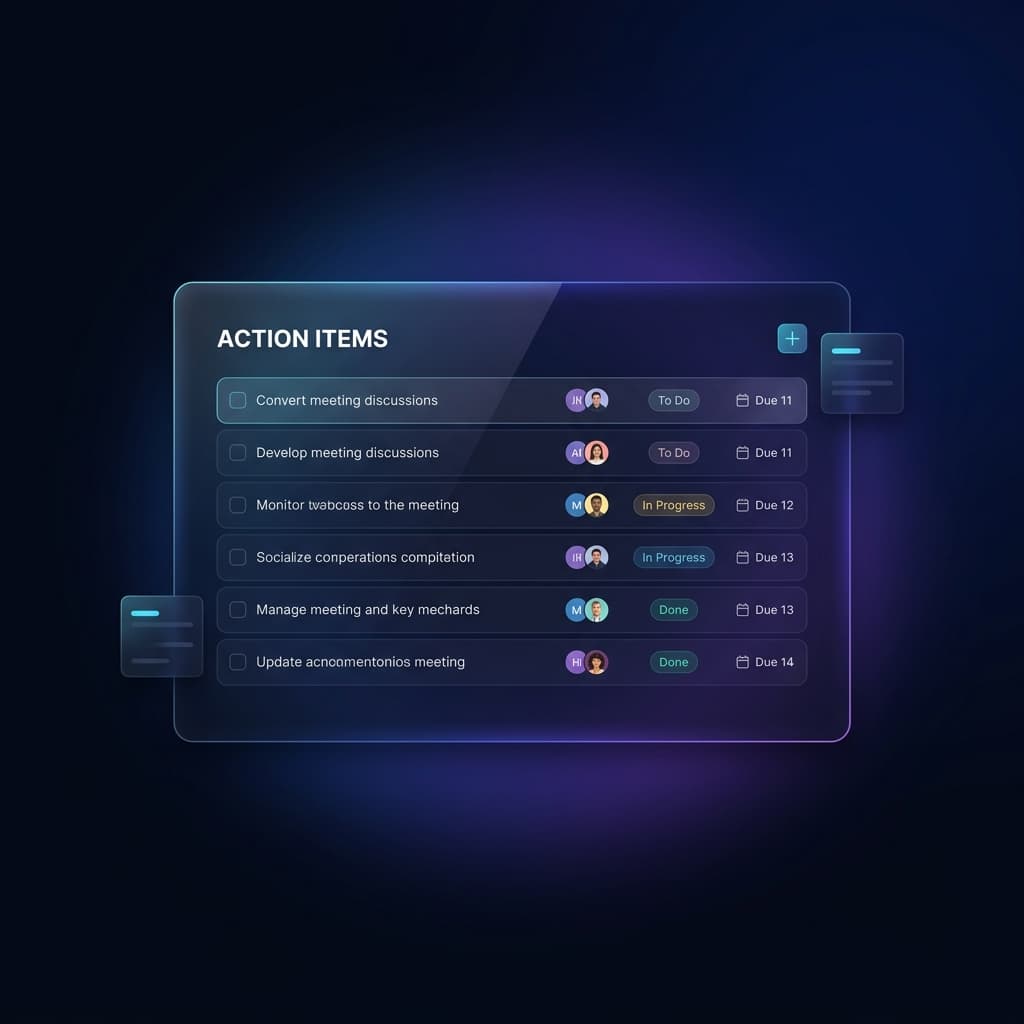
Once you have a clean, validated JSON array of action items, the final step is routing them to the systems where work actually happens.
The Webhook Dispatcher
Your application backend should act as a webhook dispatcher. When the extraction pipeline finalizes the JSON, it triggers a background job (e.g., via Celery, BullMQ, or Inngest).
Routing to Jira/Linear
Using the identity map, the dispatcher looks up the internal user_id corresponding to the assignee name. It then constructs a POST request to the Jira or Linear API:
// Example Node.js Linear API Integration
const createLinearIssue = async (actionItem, teamId, userId) => {
  const response = await fetch('https://api.linear.app/graphql', {
    method: 'POST',
    headers: { 'Authorization': `Bearer ${process.env.LINEAR_API_KEY}` },
    body: JSON.stringify({
      query: `
        mutation {
          issueCreate(input: {
            title: "${actionItem.task}",
            teamId: "${teamId}",
            assigneeId: "${userId}",
            description: "Generated from Meeting. Context: \\"${actionItem.context_quote}\\""
          }) { success issue { id } }
        }`
    })
  });
  return response.json();
};
This transforms a casual verbal commitment into a tracked, accountable ticket within seconds of the meeting concluding.
5. How Modern AI Transcription Platforms Solve This
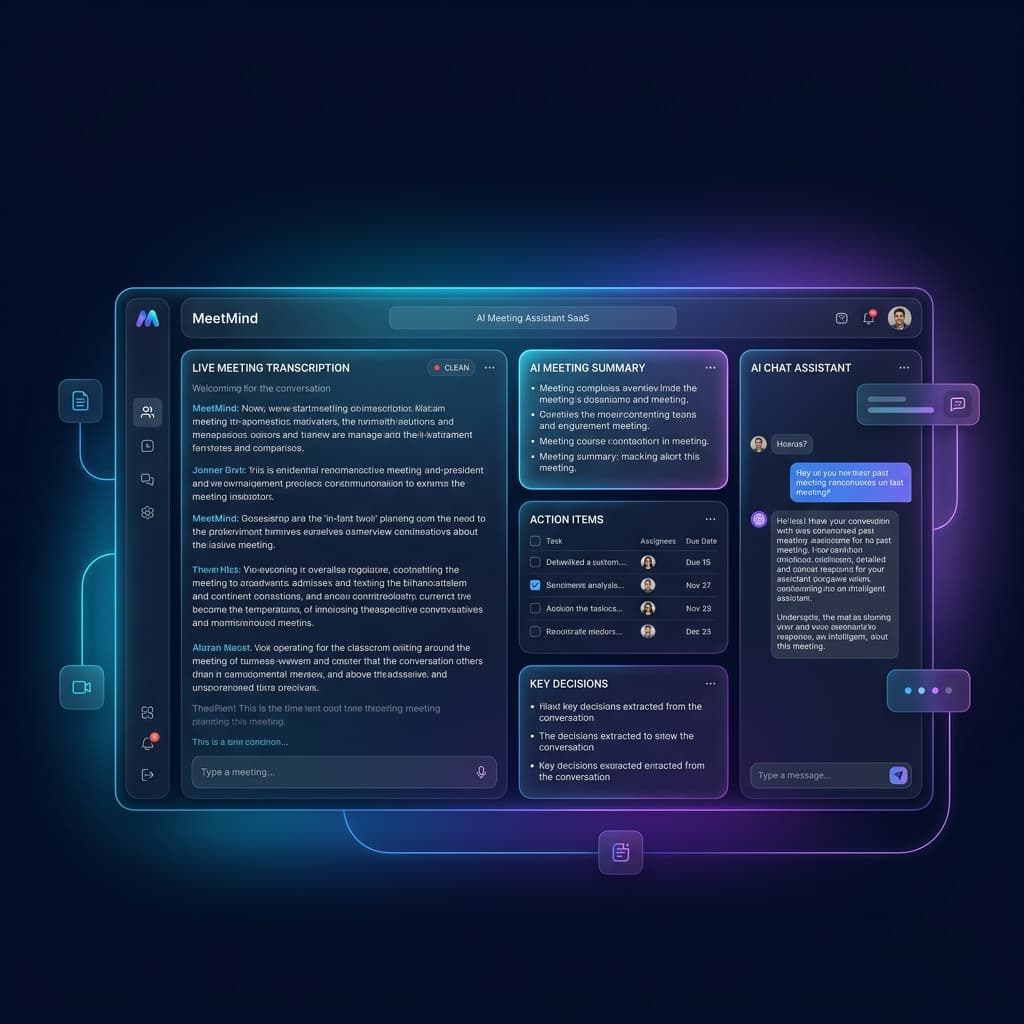
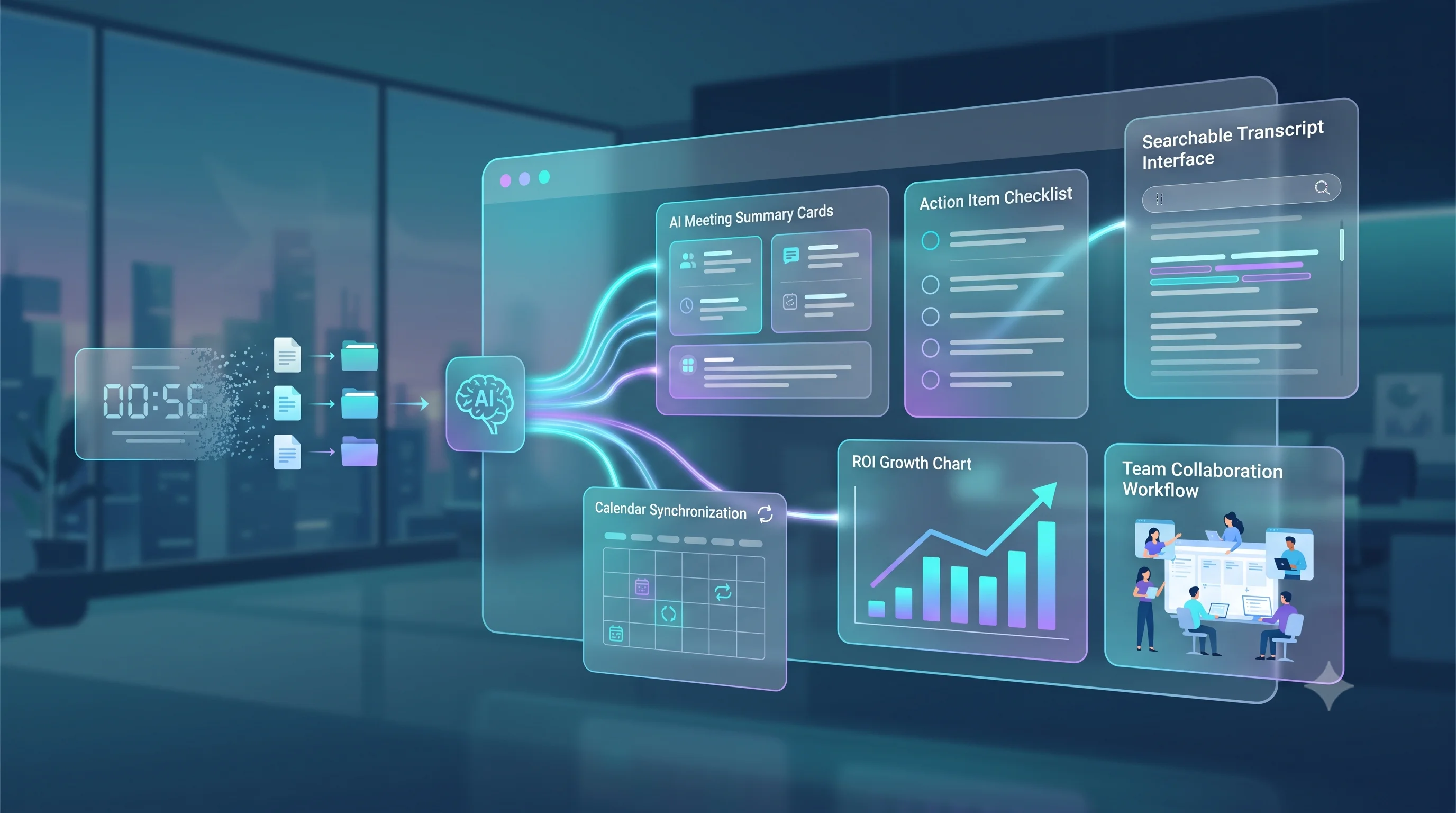
Platforms like MeetMind AI abstract this entire pipeline away from the end user, providing a seamless extraction experience out of the box.
End-to-End Orchestration
Modern platforms do not rely on a single, monolithic prompt. Instead, they orchestrate a graph of specialized AI agents:
- The Diarization Agent: Cleans the raw STT output and formats the speaker turns.
- The Identity Agent: Analyzes greetings and calendar invites to definitively map "Speaker A" to an email address.
- The Extraction Agent: Leverages OpenAI's Structured Outputs (JSON mode) to guarantee schema adherence.
- The Integration Agent: securely manages OAuth tokens to push directly into connected apps like Slack, Asana, or Notion.
By utilizing heavily fine-tuned models specifically trained on meeting corpora, platforms achieve over 95% precision in task identification, eliminating the hallucinated tasks that plague naive ChatGPT copy-pasting.
Frequently Asked Questions
Can I use open-source models for action item extraction?
Yes, models like Llama-3-8B-Instruct or Mistral perform exceptionally well at extraction when heavily prompted. However, smaller models struggle with strict JSON schema adherence. Using frameworks like Outlines or vLLM with guided decoding is required to prevent malformed JSON outputs.
How do I prevent the AI from generating tasks out of thin air?
The most effective technique is enforcing a context_quote field in your JSON schema. By forcing the LLM to provide the verbatim transcript quote that justifies the task's existence, you anchor the model to reality and drastically reduce hallucinations.
What happens if multiple people are assigned to one task?
Your JSON schema should define assignees as an array of strings, rather than a single string. The prompt must explicitly handle collective assignments (e.g., "The marketing team will handle this") by extracting the group name or breaking it into multiple individual assignees if specified.
Why not just summarize the meeting and list the tasks at the bottom?
Summarization and extraction are cognitively distinct tasks for an LLM. Summarization requires broad abstraction, while extraction requires extreme, localized precision. Combining them into one prompt degrades the quality of both. Always run them as parallel, independent LLM calls.

Written by Abhishek
I created MeetMind AI to eliminate manual note-taking and ensure teams never lose critical decisions or action items after a call. All technical content is verified against our current codebase.
Read Founder ProfileReady to eliminate manual meeting notes?
Secure your meeting data while generating accurate AI summaries in minutes.
- AI Meeting Notes & Summaries
- Automated Action Item Tracking
- Search Across Every Meeting