Table of Contents
Executive Overview
The traditional "status update" meeting is a devastating drain on organizational velocity. For a remote team of ten engineers, a daily 30-minute standup burns 25 hours of focused, deep-work capacity every week. Despite this, teams default to synchronous calls because written asynchronous updates often lack nuance, require immense discipline to maintain, and quickly become stale.
Modern AI meeting intelligence fundamentally shifts this calculus. By combining ambient audio capture with structured LLM extraction, organizations can replace synchronous reporting with Automated Documentation Loops. This guide details how to architect an asynchronous framework where specialized, highly technical conversations automatically update ticketing systems, generate executive briefings, and maintain a canonical source of truth—without requiring the whole team on a Zoom call.
1. The Anatomy of a Status Call Failure
To build an asynchronous replacement, we must first understand why status calls fail to scale in distributed environments.
The Synchronous Tax
- Context Switching: Developers require roughly 23 minutes to return to a state of deep flow after an interruption. A 15-minute sync at 10:30 AM effectively destroys the entire morning's productivity.
- Information Asymmetry: If an engineer in London misses the Pacific Time architectural sync, they must rely on subjective, often incomplete notes taken by a distracted participant.
- The "Round Robin" Inefficiency: In a 10-person status call, each individual speaks for 10% of the time and passively listens for 90%.
Why Written Async Fails
Attempting to replace status calls with written Slack threads ("Async Standups") frequently devolves into superficial updates. Writing a detailed technical blocker requires significant effort, leading engineers to write variations of "Working on Jira-102, no blockers," which provides zero operational context to the product manager.
2. Architecting the Asynchronous AI Loop
The solution is not to force engineers to write more documentation. The solution is to capture the organic, high-bandwidth conversations that happen during localized pair-programming or small triad syncs, and use AI to fan that information out to the broader organization.
Step 1: Decentralized Audio Capture
Instead of a weekly 20-person all-hands, teams break into micro-syncs (2-3 people actually working on a specific problem). These highly focused, 10-minute huddles are recorded using an ambient AI assistant. Because only the relevant parties are present, the conversation is dense, technical, and fast.
Step 2: The LLM Structuring Engine
The raw transcript of this micro-sync is useless to the broader company. It must be processed by an LLM instructed to extract specific operational vectors:
- Blockers & Dependencies: "We can't deploy because the Auth0 migration isn't merged."
- Architectural Decisions: "We decided to use Redis instead of Memcached for the rate limiter."
- Actionable Commitments: "Sarah will open the PR by 3 PM."
Step 3: The Fan-Out (Information Routing)
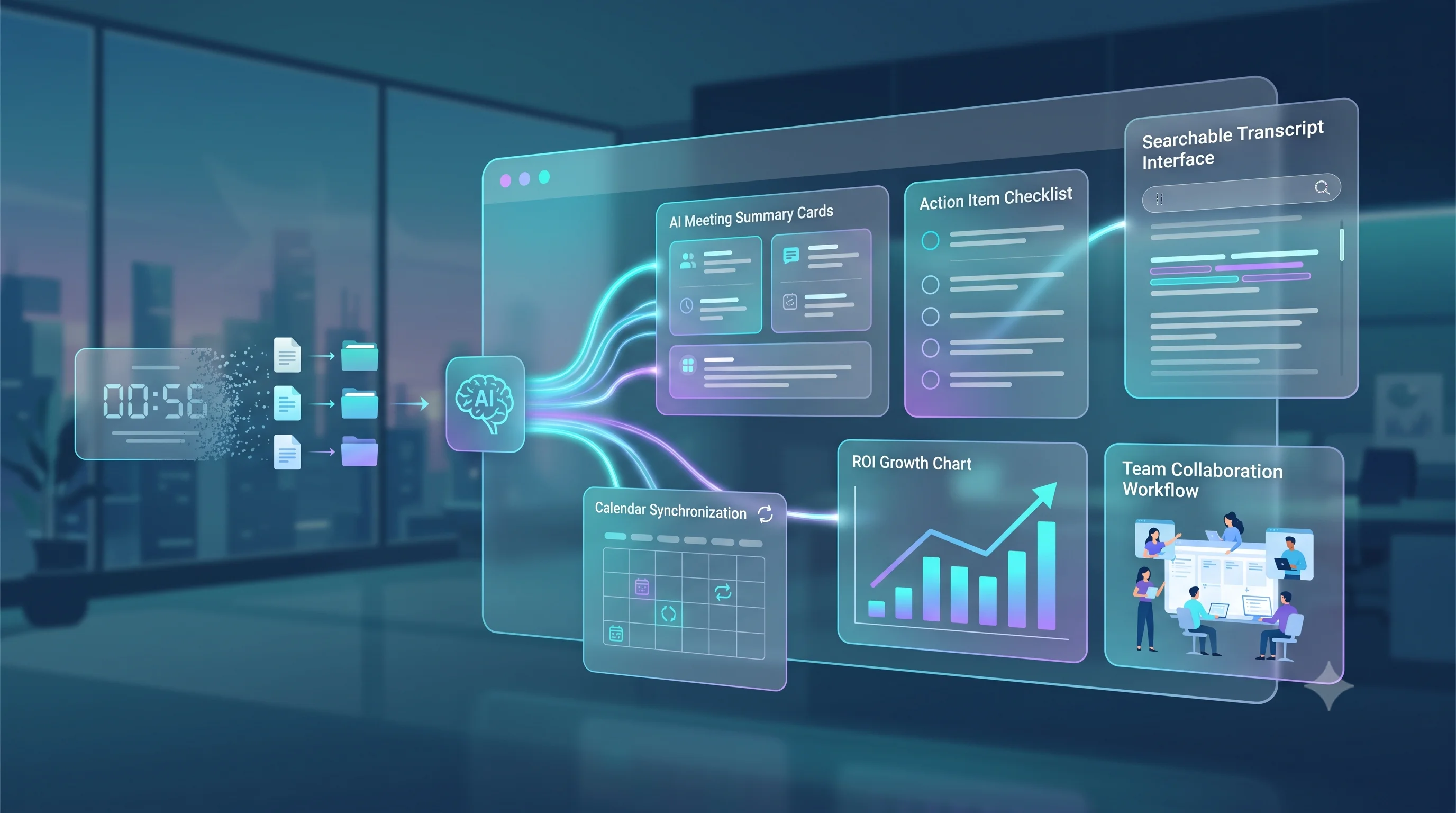
This is the critical automation step. The structured JSON output from the LLM is routed via webhooks to the systems where stakeholders live:
- Jira/Linear: Blockers automatically link to active tickets.
- Notion/Confluence: Architectural decisions append to the ADR (Architecture Decision Record) log.
- Slack/Teams: A highly condensed, 3-bullet executive summary is posted to the
#engineering-leadershipchannel.
3. Implementing the "Documentation Loop"
A documentation loop ensures that the output of one process becomes the contextual input for the next, preventing information rot.
The Daily Digest Architecture
Rather than interrupting the entire team, the asynchronous framework compiles a "Daily Digest."
The Workflow:
- Throughout Tuesday, various micro-syncs occur (Frontend pairing, Backend database review, Design QA). All are recorded and processed by the AI.
- At 5:00 PM, a CRON job triggers an aggregation script.
- An LLM prompt aggregates the 5 separate structured summaries into a single, cohesive digest.
The Aggregation Prompt:
You are a Technical Program Manager. Review the provided JSON transcripts from today's localized team syncs.
Synthesize a single Daily Digest.
1. Identify any cross-functional blockers (e.g., Frontend is waiting on Backend).
2. Summarize key technical decisions made today.
3. List pending action items grouped by Assignee.
Do not include conversational pleasantries. Format strictly in Markdown.
- On Wednesday morning at 9:00 AM, the entire company reads the Daily Digest over coffee. The 30-minute synchronous standup is completely eliminated.
4. Measuring the ROI of Asynchronous Transformation
Transitioning to this framework requires behavioral changes, but the return on investment (ROI) is highly quantifiable.
Metric 1: Reclaimed Engineering Hours
By eliminating just three 30-minute status meetings per week for a team of 15 engineers, you reclaim 22.5 hours of engineering time weekly. At a fully loaded cost of $100/hr, this equates to $117,000 in recovered capital annually, simply by removing the synchronous tax.
Metric 2: Decision Velocity
In traditional organizations, decisions wait for the "weekly steering committee." In an AI-driven asynchronous loop, a triad can make a decision on Tuesday afternoon, and the justification, context, and implications are automatically fanned out to leadership by Tuesday evening. Decision velocity increases from weekly cycles to daily or hourly cycles.
Metric 3: Documentation Freshness
Internal wikis are notoriously out of date. By piping AI-extracted meeting decisions directly into the Notion database via API, the documentation is updated as a byproduct of human conversation, rather than requiring a dedicated "documentation day."
5. How Modern AI Transcription (Whisper, Deepgram) Solves This
The entire asynchronous framework relies on near-perfect transcription. A mis-transcribed technical term (e.g., "Postgres" vs "progress") can derail an automated update.
Leveraging Whisper for Technical Jargon
OpenAI's Whisper is uniquely suited for technical environments. Because it was trained on vast amounts of internet data, it possesses an inherent understanding of software engineering vocabulary, API endpoints, and library names. This prevents the "hallucination loop" where traditional STT models fail to parse complex architectural discussions.
Deepgram for High-Volume Concurrency
When a large organization transitions to this model, they might run hundreds of micro-syncs daily. Deepgram Nova-3 provides the high-throughput, low-latency API required to process massive volumes of audio concurrently. By leveraging Deepgram's native diarization, the extraction LLM knows exactly who proposed an architectural change, maintaining accountability in the asynchronous log.
Frequently Asked Questions
Don't we lose team culture without synchronous meetings?
Synchronous time should be reserved for high-bandwidth human connection: 1-on-1s, brainstorming, strategic planning, and team-building. By eliminating rote status reporting, teams actually have more energy for meaningful synchronous collaboration.
How do we handle urgent, "hair-on-fire" blockers?
Asynchronous frameworks are for operational cadence, not incident response. If a production server is down, you still open a synchronous incident bridge. The rule of thumb is: If a decision can wait 4 hours, it should be asynchronous.
What if developers refuse to record their micro-syncs?
Adoption requires psychological safety. Ensure that ambient recordings are governed by strict retention policies (e.g., zero-retention architectures where audio is deleted immediately after transcription). Furthermore, focus on the benefit: "If you record this 10-minute huddle, the AI will update your Jira tickets for you so you don't have to."
Can this framework work for non-technical teams?
Absolutely. While the examples here focus on engineering, Sales teams use this exact framework to pipe localized deal-strategy huddles directly into Salesforce, and Marketing teams use it to route campaign decisions to Asana.

Written by Abhishek
I created MeetMind AI to eliminate manual note-taking and ensure teams never lose critical decisions or action items after a call. All technical content is verified against our current codebase.
Read Founder ProfileReady to eliminate manual meeting notes?
Secure your meeting data while generating accurate AI summaries in minutes.
- AI Meeting Notes & Summaries
- Automated Action Item Tracking
- Search Across Every Meeting