Table of Contents
In 2026, the artificial intelligence landscape is dominated by two terms that are often used interchangeably but represent entirely different paradigms of software engineering: AI Assistants and AI Agents.
Understanding the distinction isn't just an academic exercise. As businesses look to scale their productivity, choosing between an assistant that requires constant supervision and an agent that operates autonomously will define competitive advantages over the next decade.
What is an AI Assistant?
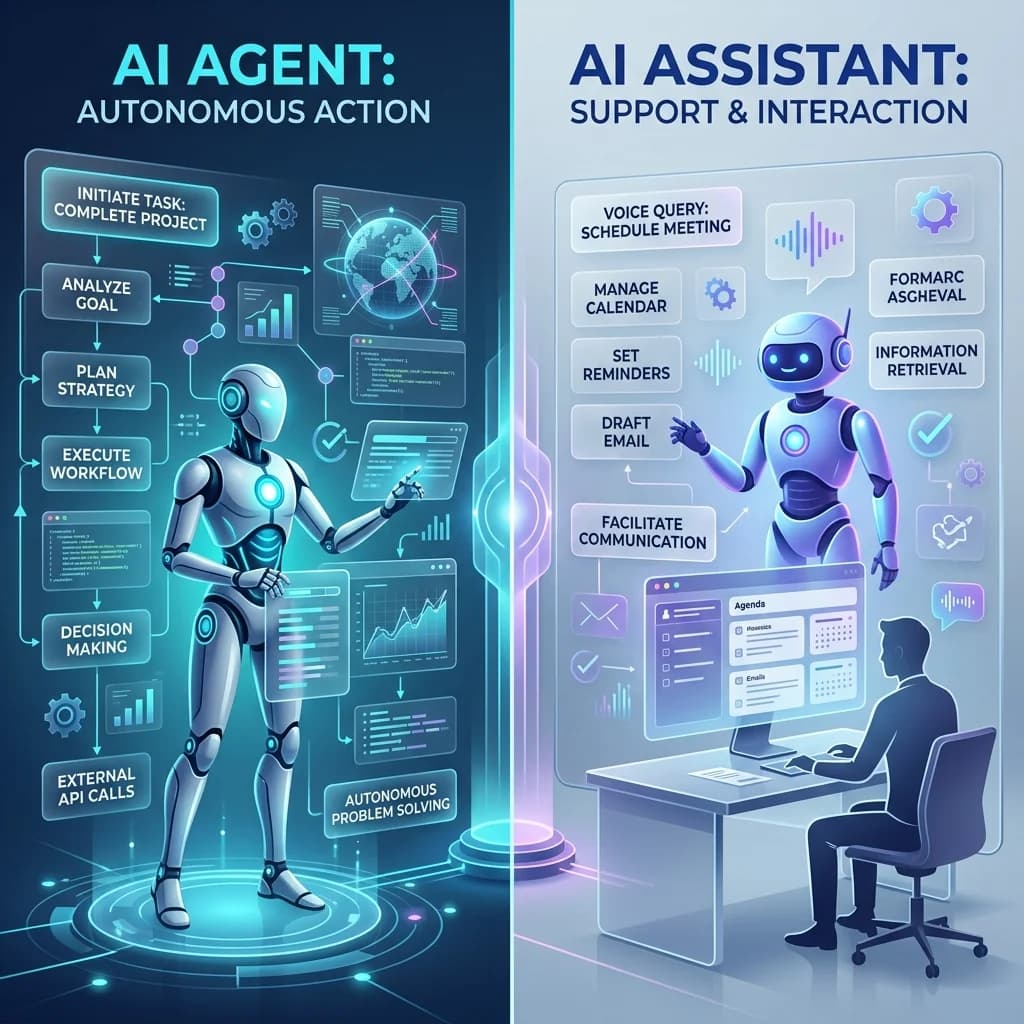
An AI Assistant is a reactive tool designed to help humans complete specific tasks more efficiently. Think of it as a highly advanced copilot that requires a human at the controls.
When you use an AI assistant, you are the orchestrator. You provide the prompt, context, and explicit instructions, and the AI returns a specific output.
Key Characteristics of AI Assistants
- Reactive Nature: They only act when prompted by a user.
- Narrow Context: They focus heavily on the immediate input window rather than long-term planning.
- Human-in-the-loop (HITL): They require continuous human oversight, manual approval, and iteration.
Examples: Standard chatbots like ChatGPT, standard inline IDE autocompletes, and manual transcription utilities.
What is an AI Agent?
An AI Agent is an autonomous or semi-autonomous system that can perceive its environment, make decisions, formulate a plan, and execute actions to achieve a high-level goal without continuous step-by-step human intervention.
If an AI assistant is a copilot, an AI agent is closer to an autopilot system. You provide a goal (e.g., "Extract action items and update project boards"), and the agent evaluates the inputs, calls external APIs, and resolves tasks.
Key Characteristics of AI Agents
- Goal-Oriented: You assign an objective, and the agent formulates multiple steps to achieve it.
- Tool & API Integration: Agents interact directly with external software endpoints (calendars, webhooks, or databases).
- Self-Evaluation & Error Handling: Advanced agentic pipelines evaluate output validity, retrying failed operations or requesting human confirmation if ambiguity exceeds safety thresholds.
Technical Comparison Matrix
| Dimension | AI Assistant Paradigm | AI Agent Paradigm |
|---|---|---|
| Execution Trigger | Manual user prompt | Event-driven or goal-oriented pipeline |
| Control Flow | Single input $\rightarrow$ Single output | Iterative loop (Plan $\rightarrow$ Tool Call $\rightarrow$ Observe $\rightarrow$ Reflect) |
| External Interaction | Passive text output | Active API / Webhook integration (see AI workflow automation) |
| Human Supervision | Mandatory for every step | Exception-based (Human-in-the-Loop on low confidence) |
The Agentic Execution Control Loop
Understanding how autonomous agents operate requires examining their iterative decision cycle:
┌─────────────┐     ┌─────────────┐     ┌──────────────────┐
│ Perception  │ ──> │ Planning &  │ ──> │ Tool Execution   │
│ (Input Data)│     │ Reasoning   │     │ (APIs / Webhooks)│
└─────────────┘     └─────────────┘     └──────────────────┘
       ▲                                          │
       │            ┌─────────────┐               │
       └─────────── │ Observation │ <─────────────┘
                    │ & Reflection│
                    └─────────────┘
Risk & Governance Matrix for Autonomous Workflows
As organizations transition from assistants to agents, establishing explicit risk boundaries prevents unauthorized system actions:
| Action Level | Workflow Target | Supervision Requirement | Operational Boundary |
|---|---|---|---|
| Low Risk | Auto-generating draft summaries | Zero-Touch (Fully Autonomous) | Read-only data processing and draft generation. |
| Medium Risk | Creating Jira tickets / Slack posts | Exception-Based (HITL on Low Confidence) | Flag ambiguous tasks for user confirmation before publishing. |
| High Risk | Modifying DB schemas / External Emails | Mandatory Human Confirmation | Require explicit manual approval before executing write calls. |
Architectural Bridge: Combining Both Paradigms
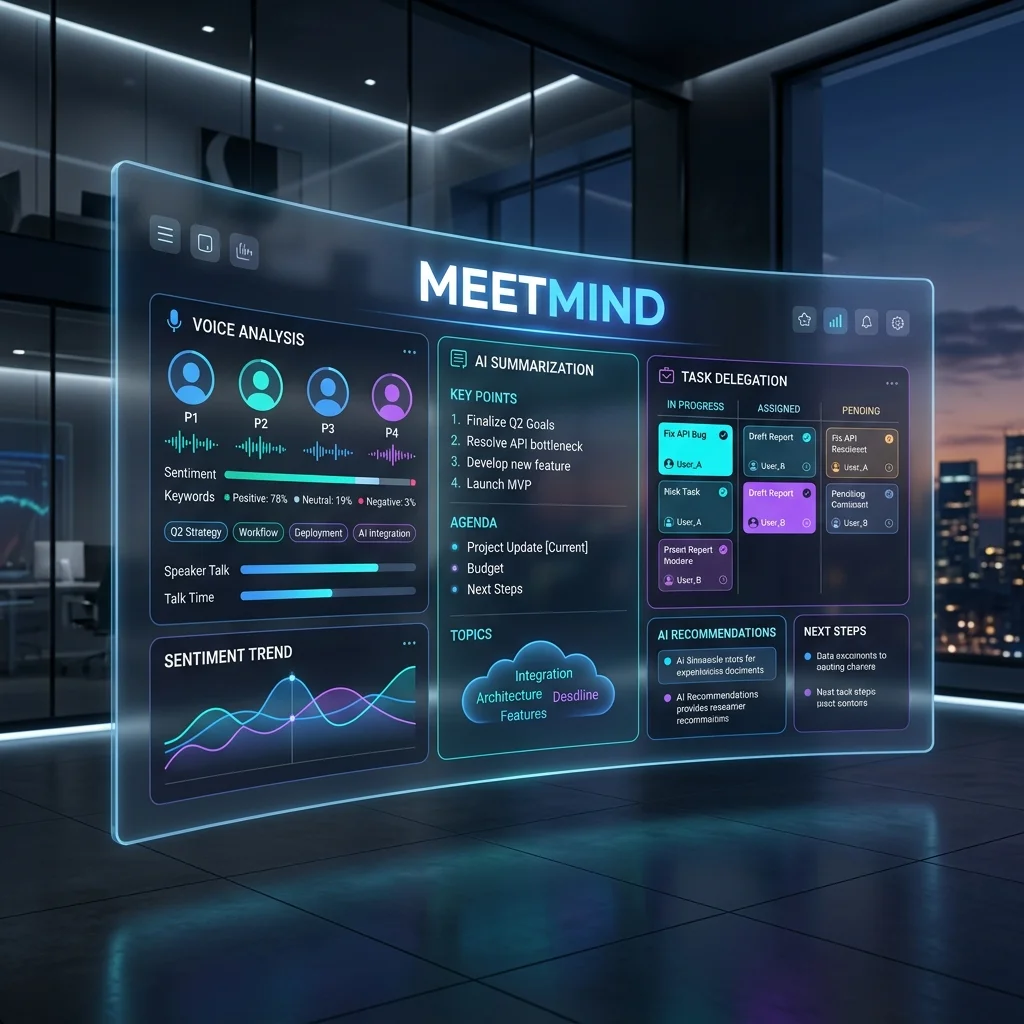
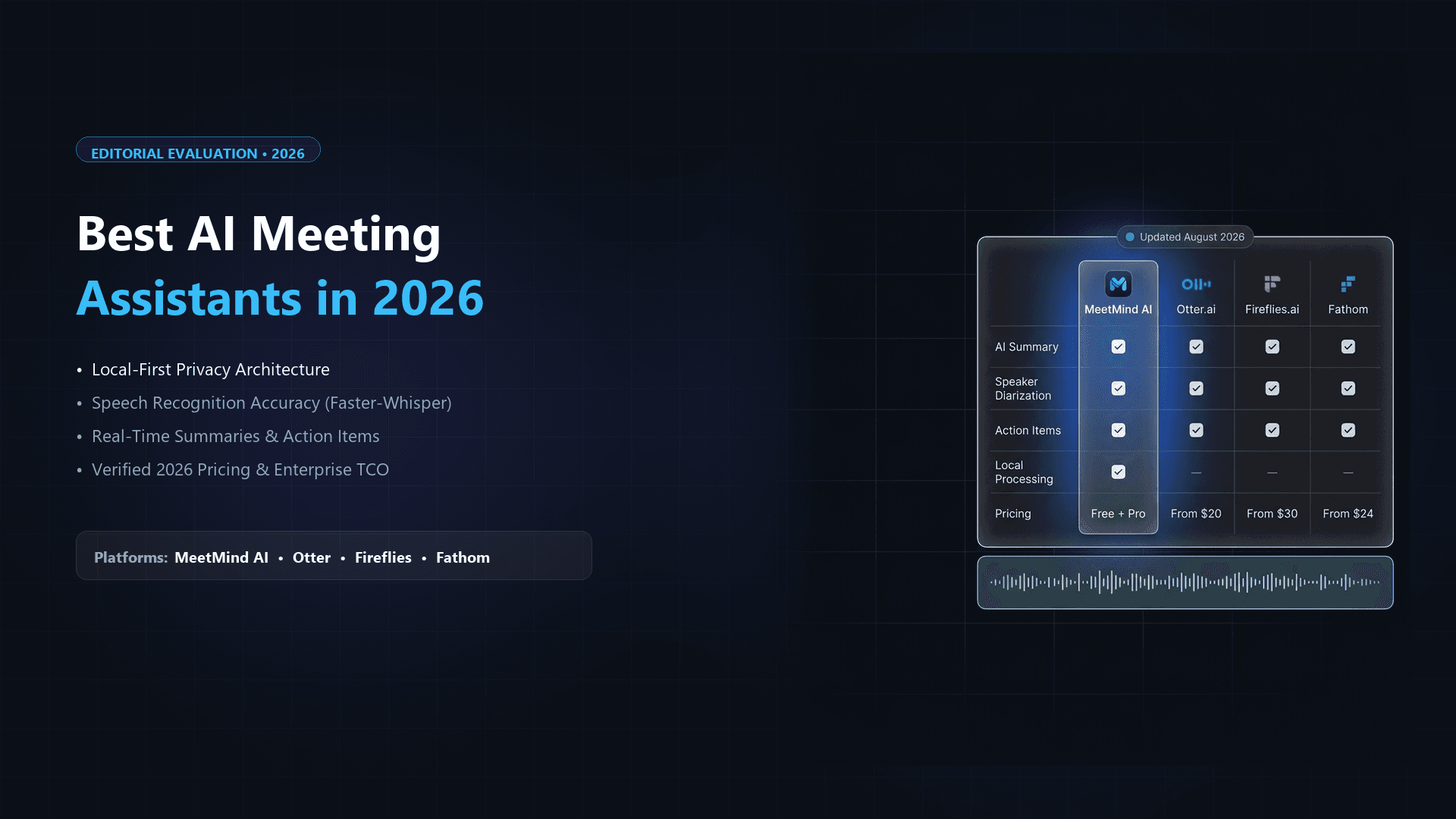
In production applications—such as meeting intelligence platforms like MeetMind AI—systems combine both assistant and agent paradigms depending on the stage of execution (see The Future of AI Meetings):
1. The Assistant Layer (Synchronous / Interactive)
During active user interaction, the system acts as an assistant. When a user queries a meeting transcript (e.g., "What deadline did the team agree on for the database migration?"), the system reactively retrieves context from the processed text and answers the question directly.
2. The Agentic Layer (Asynchronous / Automated)
When a meeting recording is completed, the system switches to automated background processing. Without requiring manual button clicks for each step, the backend:
- Ingests and processes audio via speech-to-text engines.
- Synthesizes text to identify decisions and assignees.
- Formats structured JSON schemas containing action items.
- Triggers webhooks to route structured summaries into project management software.
Deciding Between Agents and Assistants
While AI assistants are excellent for organizing and summarizing information, autonomous agents are the key to executing multi-step workflows. Assessing your specific needs—whether it is passive support or active execution—will determine which technology is right for your stack.

Written by Abhishek
I created MeetMind AI to eliminate manual note-taking and ensure teams never lose critical decisions or action items after a call. All technical content is verified against our current codebase.
Read Founder ProfileReady to eliminate manual meeting notes?
Secure your meeting data while generating accurate AI summaries in minutes.
- AI Meeting Notes & Summaries
- Automated Action Item Tracking
- Search Across Every Meeting